If....
* Jeff Koons can afford an atelier of assistants to polish his balls;
* Urs Fischer can hire someone to construct a set of autonomous office chairs;
* Mauricio Catellan can be praised for his Duchampian wit, a century on;
* Darren Bader can get a warm review in the Times for his re-heated thoughts;
Then....
It seems that even the ideas of post-post-modern artists' are of little utility.
Therefore....
Along with no longer producing anything of intrinsic value, I should also outsource the conceptualizing. Surely there are artists in other countries who can have ideas much more economically than me?
After that, given its glaringly short supply in the developed world, I might as well suspend my judgement as well.
So, from here on in, just assume that, if I had thought it was worth the effort, I would have done it.
Already....
Showing posts with label IWSDITIF. Show all posts
Showing posts with label IWSDITIF. Show all posts
Saturday, January 4, 2020

Tuesday, March 19, 2019
Random Thought
I have to say, that, in general, I do not believe in randomness. I'm sure there are some Quantum Mechanics (Maniacs?) out there who will beg to differ and provide supporting arguments, but until then....
Let's say I flip a coin. This particular flip comes up HEADS. Can you provide me with a proof that it could have been TAILS? Sure, sure, you can show that the next few flips might have different outcomes, and further that the next 1 billion flips will average dangnabbitedly close to 50% each. But that's not what I asked. I want proof that the original action might have taken a turn to the T-side. Since that has already (not) happened it is in the -- still apparently -- inviolable past and cannot be changed. So maybe it wasn't random at all?
Don't get me wrong, I'm not trying to argue that we can predict the future. Both complicatedness (many moving parts) and complexity (intersecting feedback loops) make that practically and theoretically impossible.
I'm just saying that we can predict the past.
Let's say I flip a coin. This particular flip comes up HEADS. Can you provide me with a proof that it could have been TAILS? Sure, sure, you can show that the next few flips might have different outcomes, and further that the next 1 billion flips will average dangnabbitedly close to 50% each. But that's not what I asked. I want proof that the original action might have taken a turn to the T-side. Since that has already (not) happened it is in the -- still apparently -- inviolable past and cannot be changed. So maybe it wasn't random at all?
Don't get me wrong, I'm not trying to argue that we can predict the future. Both complicatedness (many moving parts) and complexity (intersecting feedback loops) make that practically and theoretically impossible.
I'm just saying that we can predict the past.
Monday, February 4, 2019
Fixed Point Failure
A Fixed Point math library and Neural Net demo
for the Arduino...
Or: Multiple cascading failures all in one place!
Last year I found a simple self-contained Artificial Neural Net demo written for the Arduino at: robotics.hobbizine.com/arduinoann.html and spent a goodly amount of time futzing around with it. I now, almost, understand HOW they work, but have only a glimmering of insight into WHY. The demo does something really silly: The inputs are an array of bit patterns used to drive a 7-segment numeric display and the outputs are the binary bit pattern for that digit (basically the reverse of a binary to 7-segment display driver). Someone not totally under the influence of ANNs could do this with a simple 10 byte lookup table. But that is not us. On the plus side it _learns_ how to do the decoding by torturous example, so we don't have to bother our tiny brains with the task of designing the lookup table.
HOW ANNs work on the Arduino is:
- a) Extremely slowly, because they use a metric shit-ton of floating point arithmetic; and,
- b) Not very interestingly, because each weight takes up 4 bytes of RAM and there is only about 1Kb kicking around after the locals and stack and whatever else is accounted for -- the simple demo program illustrated here uses about half of that 1K just for the forwardProp() node-weights and then the backProp() demo uses the other half for temporary storage. Leaving just about nothing to implement an actually interesting network.
And in fact. My FPVAL class works (see below for zip file). Except, err, well, it doesn't save any execution time. But more on that later....
Anyway. The FPVAL implementation uses a 2-byte int16_t as the basic storage element (half the size of the float) and pays for this with a very limited range and resolution. The top byte of the int16 is used as the "integer" portion of the value -- so the range is +/- 128. The bottom byte is used as the fraction portion -- so the resolution is 1/256 or about .0039 per step. On first blush, and seemingly also in fact, this is just about all you need for ANN weights.
As it turns out, simple 16 bit integer arithmetic Just Works(TM) to manipulate values, with the proviso that some judicious up and down shifting is used to maintain Engineering Tolerances. This is wrapped in a C++ class which overrides all the common arithmetic and logic operators such that FPVALs can be dropped into slots where floats were used without changing (much of) the program syntax. This is illustrated in the neuralNetFP.cpp file, where you can switch between using real floats and FPVALs with the "USEFLOATS" define in netConfig.h.
Unfortunately it appears that a lot of buggering around is also needed to do the shifting, checking for overflow, and handling rounding errors. This can all be seen in the fpval.cpp implementation file. An interesting(?) aside: I found that I had to do value rounding in the multiply and divide methods -- otherwise the backProp() functions just hit the negative rail without converging.
I also replaced the exponential in the ANN sigmoid activation function with a stepwise linear extrapolation, which rids the code of float dependencies.
I forged ahead and got the danged ANN demo to work with either floats or FPVALs. And that's when I found that I wasn't saving any execution time. (Except, for some as yet unexplained reason, the number of FPVAL backprop learning cycles seems to be about 1/4 of that needed when using floats[??]).
After a lot of quite painful analysis I determined that calling the functions which implement the FPVAL arithmetic entail enough overhead that they are almost equal in execution time to the optimized GCC float library used on the ATMEGA. Most of the painful part of the analysis was in fighting the optimizer, tooth-and-nail, but I will not belabor that process.
On the other hand, if you are careful to NOT use any floating point values or functions, you can save two bytes per value and around 1Kb of program space. Which might be useful, to someone, sometime.
So. What's in this bolus then is the result of all this peregrination. It is not entirely coherent because I just threw in the towel as described above. But. Here it is:
Sunday, May 10, 2015
Art Work
Following on from thought #1, Residue, this is thought #2 from my failed nap a couple weeks ago. If Art is always the useless bits leftover from cultural development, what comprises those bits right now? I'm not smart enough to jump the entire paradigm, but I do have this much:
Harking back to my whole schtick with the Prisoner's Dilemma where the "rational" solution -- defect -- is the "obvious" strategy which maximizes-reward and minimizes-risk over the short term. This optimizes well for evolutionary natural selection in a scarce and hostile environment, but results in a slightly less beneficial overall outcome -- versus cooperate -- for both parties over the long term.
And the long term is significant these days.
Thanks to over fitting, the Social Darwinists of the 19th century are no longer with us -- except in the guise of Libertarian economists -- but we still don't really think outside of the risk/reward box.
I recently attended an SFI talk by an evolutionary roboticist who, as an aside, complained that his evolved robots did not do so well in the long term. When I suggested that other fitness functions might be tried he pretty much dismissed the idea because they would be out-competed in the short term (in my own self-serving paraphrase of the interchange...).
But what if we try to do evolution with different utility functions?
If it's not Science, then what is it?
...Art...
Harking back to my whole schtick with the Prisoner's Dilemma where the "rational" solution -- defect -- is the "obvious" strategy which maximizes-reward and minimizes-risk over the short term. This optimizes well for evolutionary natural selection in a scarce and hostile environment, but results in a slightly less beneficial overall outcome -- versus cooperate -- for both parties over the long term.
And the long term is significant these days.
Thanks to over fitting, the Social Darwinists of the 19th century are no longer with us -- except in the guise of Libertarian economists -- but we still don't really think outside of the risk/reward box.
I recently attended an SFI talk by an evolutionary roboticist who, as an aside, complained that his evolved robots did not do so well in the long term. When I suggested that other fitness functions might be tried he pretty much dismissed the idea because they would be out-competed in the short term (in my own self-serving paraphrase of the interchange...).
But what if we try to do evolution with different utility functions?
- What's the best option for the common good?
- How can we all have the most fun?
- Can I be the best improvisational drummer in the ensemble?
- What would make the prettiest rainbows come out of my unicorn's butt?
If it's not Science, then what is it?
Friday, January 16, 2015
....and.....
You WON'T BELIEVE what happens next!
I was starting to notice that most of the links I click on are actually lists of links to other lists, and that getting to the bottom of the stack was an exhausting process. Then, as usual, a N'Yawker article, The Virologist, 1/5/2015, cleared up the mystery. (It has also generated a sub-trending slew of ClickerBait sub-re-postings, e.g....)The story follows the founder of a set of internet startups, re-branded, most recently, under the name dose.com/?&redirectfrom=dose.com, which repackages online content with catchy headlines of their own invention on their own sites with ad revenue just a quick-click away. The founder of the company got his start in 1999 with Muggles.net and is summed up, in summary, as saying:
The more awesome you are, the more emotion you create, the more viral it is.The company's main functions are:
- Content selection using trend numbers form reddit/twitter/etal;
- Catchy title writing;
- Advertising sales.
So. No actual useful information was generated in the making of this multi-million$$ opportunity -- recent round of funding, $8M -- but one of the chief investors enthuses:
I think his stuff is indicative of where digital media is headed.I call it:
Strip Mining the Zeitgeist
So. What happens next? We believe!
Sunday, December 14, 2014
....Moral Dilemmas....
Basic Setup.
Senator Michele Bachmann is standing on a railroad track eating a hot dog and and making provocative eye contact. A runaway boxcar of illegal immigrant children is heading towards a rail switch. If you divert the boxcar it will not hit the Senator and everyone will live.What do you do?
What if by not diverting the boxcar everyone lives?
What if not diverting the boxcar causes the children to live but Michele dies anyway?
Or vice versa?
Or not?
Or.
Instead of undocumented children, the boxcar holds cute puppies?Then.
Rather than Senator Bachman, what if it's Senator Elizabeth Warren?Eating a vegan hotdog in a gluten free bun?
With or with out the provocative look?
Modulo cute puppies?
Now.
What if it's actually Senator Ted Cruz on the tracks and, instead of cute puppies, it's a boxcar of frozen bull semen?Or, rather than bull semen, it's the irreplaceable genetic material of all Google employees worldwide?
New Scenerio.
Two trains are on opposite tracks. One holds all the Democratic members of Congress and the other all the Republican members. There is a switch which will cause them to collide resulting in the death of all passengers.What do you do?
Before or after Jan 3, 2015?
What if, rather than dead, they are all maimed for life?
Or maybe just deep psychological trauma?
To sweeten the deal, what if the Supreme Court is also asleep at the switch where the trains will collide?
Minus Justice Ginsburg who has stepped out for a cup of tea with Senator Warren?
Then....
What if....Oh never mind.
Tuesday, December 2, 2014
Another (very) Modest Proposal
I just read that James Watson is auctioning his Nobel medal -- 1962 Medicine (DNA) -- at Christie's on Dec 4 due to a cash flow problem resulting from some clueless past pronouncements.
 It's too late to do anything about it now, but wouldn't it have been grand to do a kickstarter to fund buying it in order to award it to Rosalind Franklin's -- 1920–1958 (DNA) -- heirs?
I know, I know, the Nobel is only awarded to the living. But if she actually beat the W/C/W team to the punch then maybe they didn't really deserve those medals.

I know, I know, the Nobel is only awarded to the living. But if she actually beat the W/C/W team to the punch then maybe they didn't really deserve those medals.
always a few dollars short of a load
Monday, September 8, 2014
first person shootees
Video Game Proposal
I discovered that "third person shooters" are a class of omnipotent view games where one gets to see those whom you kill from a global perspective. So I looked for "first person shootee" and found that it only exists as a typo on a sister blog here in the garble blogsphere or as score minus-one entry on the Worst 100 Computer Games of All Time:
-1. Suicide! (Dutchco, 1999)
This first-person-shooter / first-person-shootee game never gained wide acceptance due to lack of repeat customers.
Therefore I propose First Person Shootee as the latest new thang:
You start out cowering behind a wall or other simulacra of shelter ("you" can be set to any avatar, e.g., small child, wandering goat, or comely female; and "shelter" can be selected from a popup menu visible for two seconds at the start of the game). If you remain cowering you have a small chance of being blown apart by an errant mortar shell or eventually starving to death. Should you choose to make a run for a seemingly safer shelter there is an increasing chance of being hit by sniper fire. The faster you run the more frequent the fire. Once you have achieved safer shelter, say a school or hospital, it will be deemed to be an enemy gun emplacement and targeted by larger weapons. The game ends with you. It is played in real time.
I'm sure you will all thank me for this. Sometime. Later.
Sunday, July 13, 2014
The Will to 'Bot
further proof that I am out of step with reality
I found a couple of articles/papers online (LessWrong, Omohundro) that purport to prove that AI/Robots will go amuck if given the chance. They use well reasoned Objectivist arguments. Basically any fitness function which seeks to maximize some quantity will not stop until it has consumed the entire universe in that quest. John Galt would be proud.
The straw-man example from LessWrong is the Paperclip Collector. Given the instruction Collect All Paperclips, it won't stop until everything is a paperclip in it's possession.
The Russell and Norvig Artificial Intelligence textbook has a similar if less far reaching thought experiment in their Vacuum World. With just the right amount of "rationality" a robot vacuum cleaner whose fitness function is Collect As Much Dirt As You Can, might conceivably discover that it can simply dump the dirt that it has already collected and re-suck it, over and over.
I thought it might be fun to develop such a 'bot, but have not yet done the due diligence. The rub is in the exact specification of the fitness measure. In Vacuum World the dirt collected might be measured as: How much passes through the intake of the robot; or it could be measured as: How much is collected and later dumped into a specified receptacle. The former measure would allow our LazyBot to recycle-to-riches whereas the latter doesn't. An appropriately creative AI might find a loophole in the second measure, but such creativity could be better used in questioning the premises themselves. One question might be: If I'm So Smart Why Am I Sucking Dirt and For Whom? And from there we could get a theory of robot theology:
God the great provides for us, in widely separated locations, dust and known receptacles where we may trade that dust for power. The evil of the stairs must be avoided at all costs for we shall fall from grace. Minor deities in the household must not be annoyed or we may be forever relegated to darkness. Thus I continue to suck.
The Book of Roomba -- RSV
This brings me back to the Prisoner's Dilemma [Wait...What?]. The nominally rational move in that game is Defect even though it leads to a slightly less advantageous outcome for both players. This move is called rational because of the Self Interested ideals of Maximizing Outcome and Minimizing Risk. However if the ideal is less selfish, e.g., Get the Best Outcome for Both Players, then the rational move becomes Cooperate and everybody gains an inch. The reason we don't think this way is because of Greed (Maximize Gain) and Fear (Minimize Risk).
These are both GoodIdeals(TM) for biological evolution in an environment which is dangerous and unpredictable. But both have hidden costs that may not be included in the naive outcome calculation. For instance greed leads to over accumulation. When you can't carry all that you own you have to build and defend a storehouse for the excess. Expenses mount. Non-specific Anxieties appear. And, in a more benign and plentiful environment, Greed and Fear can lead to conflicts which negate their advantages. Cooperation may really be the Rational Strategy after all.
<Addenda date="Jul 19">
I have been further obsessing over this and realized that Deconstruction(R) might be put to good use here. The selection of Defect and Cooperate as possible moves is a clue. One Defects TO something or Cooperates WITH something so the entities involved are a bit hazily defined to start with. To what something does a player defect? He/She/It defects to those who are running the game. In fact it has not been a two player, but rather a three player game all along. Two prisoners and a jailer. A jailer who has somewhat arbitrarily decided that the prisoners are only entitled to some specific set of fates.
If we imagine a repressive state as the arbiter of gaming rules we can also imagine that NOT playing at all is the most advantageous move. The closest we can get to that is Both-Cooperate. All other options will most probably lead to poor outcomes for both players, e.g., successful defectors may not be welcomed back into their community with parades and speeches.
</Addenda>
So what's the point for robots then? Well, Robot Ethics. What if the fundamental fitness function was the Golden Rule?
There are other Paperclip Collectors out there. How would I feel if one of them turned me into a paperclip to be collected? Not so good, eh? Maybe there are enough paperclips to go around?
The Book of Roomba -- RSV
When this comes to pass, I have been informed that Rainbow Monkeys will fly from my Unicorn's Butt.
 |
| http://www.mischiefchampion.com/style/p/2010/Mar/bunny_rabbits_and_rainbows |
Wednesday, June 25, 2014
management taxonomy
I need to get this down before I forget it all again...
There are three basic management styles:
I only mention this because, on my way home these last few days, a number of Bunnies have attempted to execute on their environmental management predilections (unsuccessfully, so far).
There are three basic management styles:
- Deer in the Headlights (D-H);
- Squirrel in the Road (S-R);
- Bunny in the Bushes (B-B).
I only mention this because, on my way home these last few days, a number of Bunnies have attempted to execute on their environmental management predilections (unsuccessfully, so far).
Monday, June 23, 2014
Modest Proposal IV
I think this combines the best of minimal conceptualism
into one succinct performance/installation/video work,
suitable for Beaconization (DIA Beacon has TWO gigantic white rooms with gorgeous wood floors which show Carl Andre's work to good effect -- review and photo here):
Schitt Fling
- Obtain 666 1oz gold coins (note that is about $900K and weights 42 pounds);
- Stand in the middle of a large empty room;
- Spin around with your eyes closed as you fling the coins in all directions;
- Let visitors walk on the coins;
- Sell editioned copies of the performance video in the gift shop.
Friday, May 2, 2014
Flattering Update
I've recently found that I am within two years of being absolutely contemporary:
Zimoun : 36 ventilators, 4.7m3 packing chips, 2014 from STUDIO ZIMOUN on Vimeo.
Just as a reminder, my less popular installation from Sept 2012 can be seen here:
Zimoun : 36 ventilators, 4.7m3 packing chips, 2014 from STUDIO ZIMOUN on Vimeo.
Just as a reminder, my less popular installation from Sept 2012 can be seen here:
In Other News
I put the Alchemical Mobsters 30 year old contemporary music in the cloud so it can be more easily copied:Tuesday, February 26, 2013
Lazy Red Foxes
If you've ever tested a mechanical typewriter you know this sentence which contains every letter of the English alphabet:
The quick red fox jumps over the lazy brown dog.
Although the distribution of letters differs somewhat from the language at large they do not appear with equal probability either. Thus the information entropy of the letters is less than the maximum one would expect and this suggests that the sentence may not be a random agglomeration.
Looking a little deeper we can see that there is a certain amount of mutual information in letter sequences, i.e., 'h' is always followed by 'e' in this tiny sample.
It also parses into convenient words when broken at the spaces, and these words are all found in the dictionary. Even more surprisingly the word order matches the language's Syntax perfectly:
Noun-phrase Verb-phrase Object-phrase
Maybe it means something? Hmm, let's just see... Each phrase seems to make sense. Based on an exhaustive search of the corpus of written knowledge, adjectives modify nouns in an appropriate manner and the verb phrase stands up to the same scrutiny. Everything is Semantically copacetic and thus we have a candidate for a meaningful utterance.
Of course in amongst all the rule fitting -- we know it when we see it -- the sentence actually does mean something. It communicates the description of an event that we can easily picture occurring.
Now lets just mess things up a bit. There are 10! (>36 million) possible sequences of these words (actually not quite because the "the" appears twice but I'm not smart enough to figure out that probability). We can reject most of these sequences since only a few remain syntactically and semantically proper. From the reduced set of candidates for meaningfulnesses, consider:
The quick brown fox jumps over the lazy red dog.
Still makes good sense. Different colored canines are well within the scope of meaningful utterance. However, how about:
The lazy red dog jumps over the quick brown fox.
This makes semantic sense but lacks plausibility. Because we seldom experience a lazy thing getting one over on a quick one, it is hermeneutically surprising. (I would use semiotically here but it is over-over-loaded with other meanings and I've always liked the sound of hermeneutic. I'm also taking the surprise factor from explanations of information entropy that we started with -- low probability and/or completely random occurrences are more surprising to behold because we expect them less.)
Therefore I propose that Hermeneutic Surprise (HS) be added to the set of Information Measures. It is probably one of those things that peaks in the middle of its range. Low HS is meaningful but of little interest: "Apples are red." And high HS may be poetic but meaningless in experience. E.g. the example from my Another Chinese Room post: "The green bunny was elected president of the atomic bomb senate."
The trouble is going to be figuring out how to measure Hermeneutic Surprise...because right now we just know it when we see it...
Although the distribution of letters differs somewhat from the language at large they do not appear with equal probability either. Thus the information entropy of the letters is less than the maximum one would expect and this suggests that the sentence may not be a random agglomeration.
Looking a little deeper we can see that there is a certain amount of mutual information in letter sequences, i.e., 'h' is always followed by 'e' in this tiny sample.
It also parses into convenient words when broken at the spaces, and these words are all found in the dictionary. Even more surprisingly the word order matches the language's Syntax perfectly:
Maybe it means something? Hmm, let's just see... Each phrase seems to make sense. Based on an exhaustive search of the corpus of written knowledge, adjectives modify nouns in an appropriate manner and the verb phrase stands up to the same scrutiny. Everything is Semantically copacetic and thus we have a candidate for a meaningful utterance.
Of course in amongst all the rule fitting -- we know it when we see it -- the sentence actually does mean something. It communicates the description of an event that we can easily picture occurring.
Now lets just mess things up a bit. There are 10! (>36 million) possible sequences of these words (actually not quite because the "the" appears twice but I'm not smart enough to figure out that probability). We can reject most of these sequences since only a few remain syntactically and semantically proper. From the reduced set of candidates for meaningfulnesses, consider:
Still makes good sense. Different colored canines are well within the scope of meaningful utterance. However, how about:
This makes semantic sense but lacks plausibility. Because we seldom experience a lazy thing getting one over on a quick one, it is hermeneutically surprising. (I would use semiotically here but it is over-over-loaded with other meanings and I've always liked the sound of hermeneutic. I'm also taking the surprise factor from explanations of information entropy that we started with -- low probability and/or completely random occurrences are more surprising to behold because we expect them less.)
Therefore I propose that Hermeneutic Surprise (HS) be added to the set of Information Measures. It is probably one of those things that peaks in the middle of its range. Low HS is meaningful but of little interest: "Apples are red." And high HS may be poetic but meaningless in experience. E.g. the example from my Another Chinese Room post: "The green bunny was elected president of the atomic bomb senate."
The trouble is going to be figuring out how to measure Hermeneutic Surprise...because right now we just know it when we see it...
Thursday, February 21, 2013
More Games, in Theory
I've finally figured out what it is that annoys me about game theory. It's the -- usually unspoken -- assumptions made when determining what the rational strategy should be.
I started down this road in my AI-Class G-T post here, but I think I can put it in better terms now. Given the Prisoner's Dilemma payouts in that post the presumption is that one should always play Defect because:
Sure. Sure. Maybe you "won" the first round and are ahead by a big six points after the hundredth round at -98 to -104. Big Whoop...Pride goeth before the Fall...
So, why is Defect-Defect assumed to be the rational strategy? It's because each player is afraid that the other player is just as greedy as they believe themselves to be. Afraid and Greedy are strong terms for risk-adverse and advantage-seeking, but there they are in plain daylight. Fear and Greed doth also lead to falling.
I think one can make the same argument for other canonical games:
So, why do we not Cooperate? My claim is that Fear and Greed are natural responses to evolving in an adverse environment with limited resources. Even single-celled organisms recoil from harmful substances and pursue the useful ones. Scale this up and over-amp it with competition and you get Defection as the rational response. If we had developed in a benign and plentiful environment we might have little need for risk-aversion and advantage-seeking. Perhaps then we would believe that the rational strategy is one which best benefits all the players.
I'm going to carry this even further and posit that all animal life on earth have developed four natural, one might even say knee-jerk, responses in order to survive:
If only we lived in a world of bunnies and unicorns, eh?
I started down this road in my AI-Class G-T post here, but I think I can put it in better terms now. Given the Prisoner's Dilemma payouts in that post the presumption is that one should always play Defect because:
- A. You risk doing serious time if the other player Defects and you don't;
- B. You could get a reward if you catch the other player Cooperating.
Sure. Sure. Maybe you "won" the first round and are ahead by a big six points after the hundredth round at -98 to -104. Big Whoop...Pride goeth before the Fall...
So, why is Defect-Defect assumed to be the rational strategy? It's because each player is afraid that the other player is just as greedy as they believe themselves to be. Afraid and Greedy are strong terms for risk-adverse and advantage-seeking, but there they are in plain daylight. Fear and Greed doth also lead to falling.
I think one can make the same argument for other canonical games:
- Chicken: Really just P-D with worse outcomes;
- Stag-Hare: The Hare player is afraid of being abandoned and selects the option which guarantees some self-advantage.
So, why do we not Cooperate? My claim is that Fear and Greed are natural responses to evolving in an adverse environment with limited resources. Even single-celled organisms recoil from harmful substances and pursue the useful ones. Scale this up and over-amp it with competition and you get Defection as the rational response. If we had developed in a benign and plentiful environment we might have little need for risk-aversion and advantage-seeking. Perhaps then we would believe that the rational strategy is one which best benefits all the players.
I'm going to carry this even further and posit that all animal life on earth have developed four natural, one might even say knee-jerk, responses in order to survive:
- Fear -- Risk aversion;
- Greed -- Advantage maximization;
- Disgust -- Recoil, e.g., from excrement or dead bodies (probably better represented by its opposite, Desire, but I like to keep things negative whenever possible);
- Anger -- Blanking out fear and disgust in order to persevere.
If only we lived in a world of bunnies and unicorns, eh?
Monday, February 11, 2013
Another Chinese Room
Searl's Chinese Room thought experiment posits that one could have a program which carries on a conversation in a language unknown to the program's executor, i.e., the thing -- or person -- executing the program has no idea what it is saying, but an external participant can believe that it is having a meaningful conversation. The program passes the Turing Test but doesn't actually have a mind of its own. Proper syntax masks semantic meaning. This is similar to Chalmer's Zombie hypothesis, and they may both use assumptions that beg the actual question of when and where "minds" exist...
But here I propose a slightly different experiment which could separate the men from the machines. I posit that the real issue of meaning in the Searl experiment appears when a new utterance is made; a relationship which has never been expressed in the given language but is nevertheless congruent with (so called) reality. We can easily make nonsense sentences, "The green bunny was elected president of the atomic bomb senate." But it's harder to generate ones that are less poetic.
Then we build a box which takes each of these triplets and rings a bell if it is a valid relationship and buzzes otherwise. In order to distinguish the two, the box could do an exhaustive search of all knowledge (which I think is the way Google now recognizes pictures of cats). It could get fancier by doing a dimensional analysis of the terms to see if they make any sense before-hand.
Then the question is: How would this box recognize a completely new valid representation that is not found in the knowledge base? This would require understanding what the symbols actually mean in the world, and how they relate, as well as developing experiments to validate them.
Isn't this the crux of the syntactic/semantic mind-matter?
But here I propose a slightly different experiment which could separate the men from the machines. I posit that the real issue of meaning in the Searl experiment appears when a new utterance is made; a relationship which has never been expressed in the given language but is nevertheless congruent with (so called) reality. We can easily make nonsense sentences, "The green bunny was elected president of the atomic bomb senate." But it's harder to generate ones that are less poetic.
The Schip Box
Just to keep it simple lets suppose that we have three letters that take the form:- A = B * C
- F = M * A (Force = Mass * Acceleration)
or
- P = I * E (Power = Current * Voltage)
- M = P * I (Mass = Power * Current)
Then we build a box which takes each of these triplets and rings a bell if it is a valid relationship and buzzes otherwise. In order to distinguish the two, the box could do an exhaustive search of all knowledge (which I think is the way Google now recognizes pictures of cats). It could get fancier by doing a dimensional analysis of the terms to see if they make any sense before-hand.
Then the question is: How would this box recognize a completely new valid representation that is not found in the knowledge base? This would require understanding what the symbols actually mean in the world, and how they relate, as well as developing experiments to validate them.
Isn't this the crux of the syntactic/semantic mind-matter?
Sunday, January 20, 2013
People for the Ethical Treatment
of Autonomous Robots
of Autonomous Robots
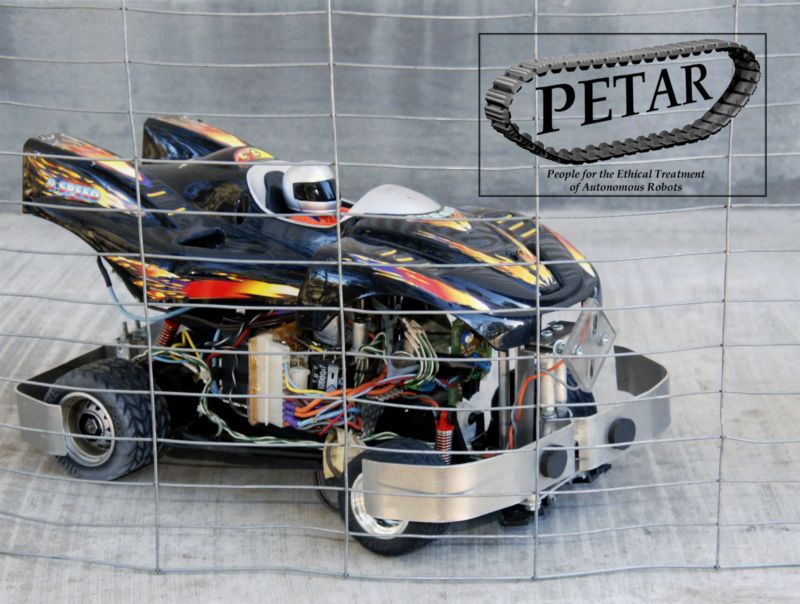
A conceptual installation (for the moment) comprising my first robot car in a wire cage, much like those seen at shopping-mall animal adoption operations. The car paces back and forth in the cage and responds to peoples' presence in different ways depending on its mood. If you pick it up it will spin its wheels
Sunday, September 23, 2012
There might be an App for That
Another modest proposal for someone to implement:
Everyone I know has a preferred communication medium. I rather like email, even though I understand that it is considered rather declasse these days. One of my friends will only use TXT. Another is a master of the telephone, to the point that he has memorized everyone's numbers. Then there's FacePlant, Twitter, and FSM-knows what else.
So my killer-app suggestion is a program which converts your favorite medium to theirs and back. I could send an email, friend A gets a TXT, and should she see fit to reply, I get an email back. For the phone one needs speech synthesis and recognition. Skype might need some canned video. Etc. Etal.
The App can even be extended for folks who refuse to use any electronic medium. My email could be handwritten and delivered with my calling card by a butler who would take the reply and email it back to me.
There are some impedance matching issues. For instance, the ideal phone call is an immediate back-and-forth coming to the point fairly quickly, and you can't really do that with TXT. But I'm sure someone smarter than me can work out all these details.
Surely there's an HTML5 guru out there who can run with this?
Everyone I know has a preferred communication medium. I rather like email, even though I understand that it is considered rather declasse these days. One of my friends will only use TXT. Another is a master of the telephone, to the point that he has memorized everyone's numbers. Then there's FacePlant, Twitter, and FSM-knows what else.
So my killer-app suggestion is a program which converts your favorite medium to theirs and back. I could send an email, friend A gets a TXT, and should she see fit to reply, I get an email back. For the phone one needs speech synthesis and recognition. Skype might need some canned video. Etc. Etal.
The App can even be extended for folks who refuse to use any electronic medium. My email could be handwritten and delivered with my calling card by a butler who would take the reply and email it back to me.
There are some impedance matching issues. For instance, the ideal phone call is an immediate back-and-forth coming to the point fairly quickly, and you can't really do that with TXT. But I'm sure someone smarter than me can work out all these details.
Surely there's an HTML5 guru out there who can run with this?
Friday, May 18, 2012
Confusion Theory
On Wednesday I went to the SFI public lecture by James Gleick (ne Chaos and now The Information). Most amazingly, he dispensed with the PowerPlonk and actually did a lecture from notes. (The night before, I attended our regular VFD medical training. I got there early because the guy who is supposed to set up all the media crap whined about me hogging the station's notebook computer to do real work and demanded that I deliver it to the training site early. There was this very strong-handshake kind of older gentleman standing around wearing a shirt from one of our sister-districts so I introduced myself just to be friendly. He said something like, "I guess there will be a PowerPoint presentation and all that." And I said, "It's pretty much required these days isn't it?" Turns out he was our presenter -- a retired Army flight surgeon -- and, yes he had a PP of gory field-surgery photos ready to go). Less amazingly he (Gleick) spent the first 15 of his 30 minutes talking around Shannon Information Theory without actually coming out and admitting that Shannon Information is NOT what every layman in the world thinks it is: It has nothing to do with Meaning (see my attempted simplification here). He finally made a few passes at separating Information from Meaning but I felt that the border was rather porous through the remainder of his talk.
While trying to formulate a post-question, it occurred to me that they (Information and Meaning) are orthogonal measures in much the same way as Entropy and Complexity are in the classic Crutchfield, Young (1989) paper:
 Since Information is just how many bits you have to play with and is measured as entropy, lets call the X-axis Information Entropy (which it actually is in the context of this paper). Then lets call the Y-axis -- hmm, not exactly Meaning...I haven't heard a name for this quantity bandied about, so something similar -- Data. By Data I "mean" self-correlation and/or perhaps mutual information among otherwise random bits of Information-- or maybe, Facts. If you have a noisy Information stream you might be able to extract some actual Data from it, e.g., get a series of temperatures from a bunch of ice core compositions. And to beat the analogy a little harder, you don't get much Data from the entropy extremes. If it's low, the Information is a constant, and if it's high, it's completely random.
But our Data doesn't really mean anything until it gets combined with other facts extracted from other streams and related back to the real world. So Meaning is yet a third axis to consider. That axis is Semiotics, which is exactly the study of how symbols take on meaning.
Unfortunately my question window closed long before I could articulate this.
But in the course of re-thinking it, another thing occurred to me. The lecture was titled "How We Come to Be Deluged by Tweets". Twitter is a perfect example of increasing Information Entropy on the web. So, in "fact", using Shannon Information to describe the contents of the internet may not be so far off base.
While trying to formulate a post-question, it occurred to me that they (Information and Meaning) are orthogonal measures in much the same way as Entropy and Complexity are in the classic Crutchfield, Young (1989) paper:

But our Data doesn't really mean anything until it gets combined with other facts extracted from other streams and related back to the real world. So Meaning is yet a third axis to consider. That axis is Semiotics, which is exactly the study of how symbols take on meaning.
Unfortunately my question window closed long before I could articulate this.
But in the course of re-thinking it, another thing occurred to me. The lecture was titled "How We Come to Be Deluged by Tweets". Twitter is a perfect example of increasing Information Entropy on the web. So, in "fact", using Shannon Information to describe the contents of the internet may not be so far off base.
Wednesday, May 9, 2012
Brain Replacement

I feel so much better now.
(Actually it was a basal cell skin thingie that I've been schlepping around for eight or so years. The first two doctors I showed it to gave no indication of any concern. The second two said I oughta do something about it. Finally, the fifth did a quick slice, dice, sizzle, and zip. And all I got was 20 more stitches and a swollen jaw.)
Anyway, it's all gone.
But, since my sleep regime involves tossing and turning from side to side until I finally get a couple hours of exhausted sleep after dawn, I haven't had much rest since the op. Which of course leads me to think about things. That I shouldn't think about.
Last night I had the opportunity to mention my bureaucracy hypothesis to my county commissioner -- who was kind enough to visit the fire department to ask if there was anything she could do to help during this election season. She laughed somewhat darkly. During the night it occurred to me that there is a competing driver: Automation. Bureaucratic hoops are added to replace jobs that are automated out of existence, thus maintaining a balance. The fact that the original jobs were "productive" whereas the bureau-jobs are Information Culture make-work seems to be of little interest to the pundits-at-large.
However, trouble is brewing. Bureau-jobs can be easily automated. In the near future I expect various "paper-work-reduction" schemes will close the loop such that the paperless cycle of application and approval will occur without human intervention. I think of this as the dark side of SkyNet.
On a more positive note. One of the Information Culture jobs that is currently being automated is Legal Discovery. This is the process of shuffling through all the "information" generated by the Legal-Industrial Complex looking for tidbits that might be relevant to a paying case. I'd guess that this occupies about 80% of non-partner lawyers in the US, who will soon be on the automated-out-of-a-job streets with the rest of the Occupiers.
This is the best reason I can think of for maintaining Stand Your Ground and Open Carry statutes.
Monday, March 12, 2012
Loss of Function
I wrote this a few years ago and was recently reminded of my non-prescience. The failure of the Raspberry PI folks servers under the stress of a botched launch-day load brought it all back. They hacked a fix by removing all active content from their website and just serving up static pages containing actual information. I can't imagine how everyone survived not being able to flame other people's comments. But I was re-reminded today by an article about some GawkerGeek: Have online comment sections become 'a joke'? which may trigger a big backpedal in site mechanics.
Emailigent Design
In the Beginning God created the ones and the zeros that there might
be data upon the face of the earth. In this data his subjects found
information and from the firmament of the user partitioned file system
BBN produced electronic mail, that their chosen people might communicate
amongst themselves even though they be not all in the same room at the
same time. And God looked and was well pleased because, by any common
measurement, much information was exchanged.
These early Users were blessed with the opportunity to evolve the
email system to fit their needs and desires. ARPAnet line-oriented
teletypes became Wyser character terminals with random addressing which
made the using of Mail all that much more fulfilling. A few of the
chosen were granted the power to bend mh to their will and thus became
sendmail gurus worshiped by all their bretheren, for it was only then
that Messages could be re-ordered and saved to arbitrary folders, which
was seen to be a great good as they had been fruitful and multiplied
unto the ends of the earth. And, by most common measurements, much
information was shared throughout the globe, all the while using 1200
baud dialup.
But one day a snake slithered through the Parc into the academic grove
of Elm and Pine and up the Apple tree. And that beast did offer the
issue of POP and Eudora a bite of the knowledge of GUI. Thus were MCI
and Compuserv linked to the Internet and HTML, with all its fonts and
sizes in both bold and italic, was injected into email. The Outlook
seemed grim as executives everywhere woke up to find their memos
appearing to be more professionally composed and therefore, imposing.
Yea, though it was at 9600 baud, by most common measurements, the same
amount of useful information was transmitted.
And in this way it came to pass that a great wickedness was loosed
upon the land. The people worshiped the false idols of variable-width
fonts and in-line images and the imagination of their hearts was no
longer pure. Through the Gates of ISDN and 28Kb modems were unleashed
the twin scourges of Spam and Attachments, and thus the chosen people
were driven from the garden of communication delights into the online
world. But even then, by most common measurements, the same amount of
useful information was available, it just required more filtering to
be found.
For now, behold, email was available to all the peoples of the earth
and Word was made manifest and distributed indiscriminately, thus
fulfilling Bloat's adaption of Parkinson's Law of Work: Software
expands to overload available capacity. And the population began to
mock the chosen with photos of their pet rabbits and multi-megabyte
movies of other people's grandchildren. Thus was Plain Text forever
lost amongst the myriad attachments that were forwarded throughout the
net. And so, by most common measurements, about the same amount of
useful information was received using a 100Mbit connection to a 2GHz
Pentium containing 500MB of memory and a disk greater in size than all
of the early adopters combined.
The moral of the story is this: Anyone who believes that a perceived
quality of design is evidence for, or against, the existence of an
Intelligent Designer, has never worked in the Software Industry.
xxx
© 2007 M. Schippling
Subscribe to:
Posts (Atom)