Showing posts with label art-sci. Show all posts

Sunday, October 21, 2018

Variations Too -- (semi-final) assembly

Semi-final, in theory, as I might get around to integrating a rasPi with video detection to run some smarter pattern development and to be able to communicate amongst a group of these guys in order to pass steps around the dance circle. Thus implementing Variations 3.20. Someday.

But for now....

I went for a weighty base made of a 20" long piece of 6x2x1/4" steel U-channel that I had lying around in another of my massively parallel storage areas and drilled mounting holes (or mis-drilled in some cases) for everything I could think of:

top of the heavy steel base

Here's all the sensor and controller wiring before the motor assembly was mounted:
wiring underneath

The controller is an Arduino Pro-Mini mounted on a carrier board of my own design that provides powered connectors for most I/O and some other accessory features. If you're wondering, here are the files (the design is done using the ExpressPCB.com proprietary software because I ABSOLUTELY REFUSE to use the popular Program Which Shall Not Be Named):

RoboAssist files

Wiring the motors around the arm rotation points is ad-hoc, and a Royal PITA. I left enough slack at each junction to allow rotation without dragging the wires into the gears. It would have been easier if I had just bitten the bullet and bought servo extension cords. Maybe.

So here's the final:
Variations Too

And a little demo run:


Now on to the software....

Friday, October 19, 2018

Variations Too -- taxonomic exegesis

Lemme take a little timeout here to explain my naming scheme.

As I mentioned earlier, the ur-text for all this was my proposal for an installation called Variations For, which was a pun on the 1960s John Cage piece Variations IV. Get it? Ha. Ha.

Failing to make headway on that, for lack of tens of thousands of dollars and square feet to house and feed Industrial Robots, I realized that I might be able to make my own set of simpler robot arms along the lines of the sketch in the first of these blog entries. That also faltered along technical and financial lines.

Recently, working on reducing my horizons, it occurred that I might at least be able to make ONE damn robot arm and get it to do something. Thus came to be Variations Too. You may have realized this is a pun on Two, as well, as meaning, Also. Ha. Ha.

So. Should VToo work, I will have a base model from which to construct four more. (For, more, still with me? Ha. Ha.) And that will be the basis for developing the real idea of making a set of robots that choreograph a dance together under their own direction -- even if it is still in only two dimensions. That version I would call Variations 3.20, because it is the first 80% of Variations For, where the last 80% is "just" programming the industrial robots. That's an engineering joke. Ha. Ha.

Anyway.... Next time, some more about the final construction.

Thursday, October 18, 2018

Variations -- on a linkage

Here's another video of the Variations Too robot arm in action:


For aesthetic reasons I fixated on being able to get the arms to fold up in the "parked" position as seen at the beginning and end of that video. Since almost all hobby servos only travel around 180 degrees, and ones that do travel further are more expensive, less powerful, and slower, I needed a 1::2 rotation step up; and, to maintain the sense of servo position it needs to be a timing belt or gear. Since timing belts are even harder to come-by, gears were the choice. Using a gear linkage also isolates the weight of the driven arms from the bearings in the motors themselves. It also allows the motors to be used as sorta-counter-weights, being mounted on the opposite side of the rotational bearing from the main weight of the arm. At this writing it remains to be seen how this all plays out, but here's a picture of the mechanism:


The arms are made from two different thicknesses of plexiglas, as can be somewhat discerned from the linkage photo. The lowest arm is .170" and the others are .120". In retrospect, for rigidity, I might use the thicker material for the second lowest arm as well.

The motors each have different 'vertical' spacing from the mounts to where a gear might be conveniently centered on the spline. In all cases I used the little rubber bushings that come with each motor for spacing and isolation. In addition to the bushings the HS-645MG motor needs about .250" more space, which is conveniently just about two thicknesses of the .120" plastic. The HS-755HB only needed an extra .180", so I cut a spacer from .060" material. The HS-225BB was just about right with only it's bushings mounted on .120" arm. These spacers also allow for a stronger motor and bushing mount.

All the motors are attached using #4-40 bolts, and it turns out that standard 3/8" and 1/2" lengths are nearly perfect -- for once. I found that one needs to be fairly careful with hole sizes when press fitting and bolting the various shafts, bushings, and bolts. So I used appropriate reamers and taps to make the holes work -- as cut they all seemed to be a bit undersized. Also note that the 645's will need to have some of their rubber bushings trimmed to clear the E-ring that binds, and the 755 needs to have a bit of the mounting bracket bored out as well, to clear the main bushing. These things will become apparent as you mock-up the assembly.

I've changed the design of the fixed (small, black) gear mounting slightly so I'll just describe the idea. The gear needs a spacer to the arm on which it is attached, and .120" is just about right. I cut some rings that -- should have -- fit over the gear flange while remaining clear of the teeth, with the idea that the ring would be glued to the gear (thank god for Goop!). If you try to copy this mechanism you will need to fiddle with the sizes to get it right, a close, but not tight fit is needed. Once the ring is set in place the excess gear flange needs to be cut away, so in the final assembly the gear and spacer are flush with the mounting arm, and the axle goes all the way through arm and backing plate. BTW, I used the backing plates to strengthen the axle mounting area and to locate two pins that (hopefully) will tie the whole room together. Those pins are not shown in any of the photos. They are small brass brads that run through backing, arm, and most of the gear. But I'm getting a bit ahead...

For the axle I used 1/4" DOM tube with a 3/16" hole, thinking to minimize weight and that I might run wires though the tube. The tube tends to run larger in O.D., so the bushings and gears need to be reamed out a bit. I think using tube doesn't matter, so you could easily find some nice 1/4" drill rod or something instead. The axle needs to have a notch for the E-ring clip that holds everything together. The clips are about .020" thick, but the thinnest cutting tool I could find was .040" so there's a bit of slop. The notch is around .030" deep. Careful attention needs to be paid to removing flashing from the ends and the notch edges, so the whole axle slides through the bushing cleanly. The bushing is a standard 1/4" I.D, 1/2" long, flange, that presses into a 3/8" hole.

I press fit the gear onto the axle with the bushing and E-clip in place PLUS a .015" (or so) shim between the gear and bushing to maintain some operating clearance. When the gear is positioned correctly you can remove the bushing and shim. If you haven't yet trimmed the gear flange you can put the axle in the lathe and use the clip notching tool to get it all nice.

When everything is ready the, axle can be pressed into the holding arm and backing plate, and the the bushing pressed into the other arm where it belongs -- I think a slight countersink to the receiving side of that mounting hole will help the bushing seat. Once pressed together use some of the "water thin" plexiglas adhesive (Methylene Chloride) to wick into any place where two layers of anything should not move, and clamp lightly until set.

When set, the fixed-gear arm can be drilled for the 'anti-rotation' pins and they can be Gooped in place.

Sounds simple, eh?

Monday, October 15, 2018

Variations Too -- getting it up


Having done all the previously described hacking and hewing of robot arms, I finally assembled them and cut out a mounting bracket to hold the lowest and largest of the motors. Since the base motor only has to travel 180 degrees I dispensed with gearing and invented an inline bushing support. This is fortunate because the lower motor also has a completely different spline, for which the included wheel is the only mating component I could find -- I really am not sure what these people are thinking, but I guess the whole after-market of robot builders was not on their radar when the servo motor folks were planning their product lines.

For the lower arm support I used a bronze bushing centered on the motor wheel and inserted through the arm which is sandwiched to the wheel. The wheel is then bolted onto the motor spline. A short axle inserted into the bushing supports the arm and is screwed to the motor mount U bracket in a manner that allows a bit of fiddling to get everything centered. And speaking of centering to start with ... I got the spline-wheel centered and bored a 3/8" indent into which I could locate the end of the bushing, which was then press fit through the whole sandwich.

Then I re-re-hacked an Arduino servo motor driving program I had from a previous attempt -- with the MeArm, which is a nice design but unfortunately both under-powered and under-whelming. But have a look anyway:

https://shop.mime.co.uk/collections/mearm

I clamped the whole thing down on the workbench and fired it up. And. It kinda works! But it was too flimsy with five arms, so the final product uses only four. Here's the first recorded run:


This means that I'm going to have to find something else to waste $200 on in order to be really disappointed.

Maybe next time...

Saturday, October 13, 2018

Variations Too -- getting armed

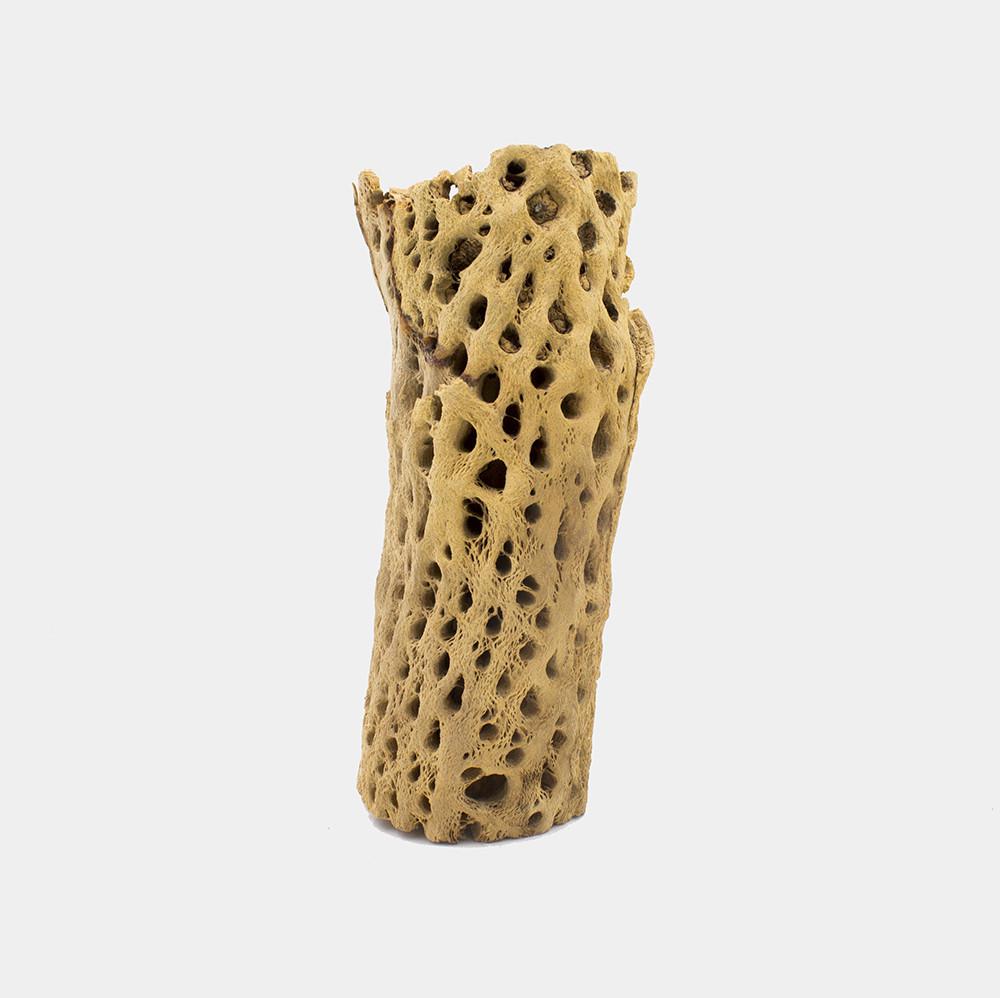
To build my robot arms I stole an idea from one of my Make Santa Fe cohorts and generated a cutout pattern -- to reduce weight, certainly NOT for any decorative purpose whatsoever -- from a photo of cholla cactus trunks which I stole from an online aquarium supply store -- ??? who knew fish like to hide in cholla remains ???.
cholla chunk


Some detail about this process might prove useful to our future selves...

I found a decent photograph online and a web site that does "free" Raster-to-Vector conversions, if you have good images.  I don't know how scammish this site is but, NoThanks-ing various pleading messages got me to where I could use it to convert images to vector outlines in DXF format.

  https://online.rapidresizer.com/tracer.php

Strangely it worked well. I massaged the vector files to be useful to my purposes -- removing decorative and practical bits of material from some robot arms in order to slightly reduce their weight.

All the cactus files are here: My cholla files

  • cholla2orig*.jpg are the original and P-shop massaged images.
  • cholla3.* are the resulting vector data, and a jpg image thereof.
  • cholla3ed.* are my editing of that data for use on the robot arms.

The non-orig JPG images are for reference purposes, and the .dxf files are what you need to load into a vector editing or cutter driving program.  The DXF files may have bizarre scales -- the conversion came out to look like it was 64 feet wide -- so pay attention to the sizes... The .CAD files are the native format for the ancient drawing program I have.

Combining all the data, I cobbled together designs for five arms of different lengths using the different motors. So. Here. After all the measuring and converting is a motor with gears, mounted in a laser-cut robot-arm-like contraption:
arm with motor and gears

And the DXF files: Long arm and Shorter arms. (Note that these files are preliminary and some finessing is still TBD.)

<EDIT 10/21/18> I think I fixed the files -- added spacers and other odd bits to the "shorter" one -- but still, check the mechanical hole sizes:  Long arm and Shorter arms.</EDIT>

I cut the arms using the MSFe Zing laser cutter, which has some quirks. Chief among these for purposes of mechanical design is a somewhat variable kerf and a reasonable but unmentioned assumption about circular hole sizes. Fortunately the centering of holes is pretty spot on and the size assumption is that the drawn hole size is an ID -- so holes come out just about as you would expect. However, if one is cutting out round plugs, the kerf needs to be considered. Thus YMMV when using my files to try to make a copy of my arms, and test runs are advised. Also, judicious reaming and taping of holes is indicated during assembly.

More discussion of the design and gear linkage will follow...

Wednesday, October 10, 2018

Variations Too -- run up


And so, a couple months ago I came down with a (tiny) fit of organizing fever and cleared up a small portion of a pathway in (one of) my massively parallel parts storage areas. I found some crappy motors I had gotten (cheap) from a surplus place that I had attempted to make into a 2-d swinging robot arm, to make even some small progress on the big proposal.

They didn't work worth a damn:
picture of crappy motors

But, out of curiosity, I found a sketch of my intentions in an old notebook from 2014 (where you can clearly see why I do not practice drawing and painting as a profession):
 picture of robot arm crappy drawing


I got to thinking that maybe I could re-start the whole project by actually spending money to get motors and components that might work.  (Over this course I realized that I could spend $200 on oysters and gin and have a fine time with friends for an evening, or I could spend -- well, more, but in the ballpark -- on motors and gears, and get in a week or two of mostly enjoyable fiddling around before discovering that things weren't going to work; so, bang for buck over hours this is a way more economically efficient alternative.)

There ensued a couple weeks of web surfing trying to figure out what "hobby servo" motors to get, even though I already have about 50 random ones.

There are a number of vendors.

Each has around 100 choices.

The choices are mostly incommensurate.

Comparing across the sources, and sometimes within a single source, is problematic. Plus there are around 10 different output shaft "spline" configurations, that are often not even specified in the literature. I finally realized that I had to stick to one source (servocity.com, the high price spread, but has reasonably complete spec sheets). And this lead me to realize that I had only two choices of splines because they were the only two that had available matching gears to be attached. So I got an assortment of the highest power motors with the same matching splines, and a buncha gears:

servo boxes

Then, waiting on UPS Ground cheap(er) shipping, I thought I would just go ahead and design the mounting brackets and all. Thus I found that not even the motor manufacturer has mechanical drawings of their products (I did find one 3d rendering of one that I could rotate around in virtual space, which was kinda fun). Of course, one of the main things one wants to know when designing mounting plates for geared mechanisms is: How far is the output shaft from the mounting holes?

So. After the motors arrived I managed to measure and estimate the necessary and the gears seem to mesh OK. Just in case, here is my DXF drawing of the Hitek HS-225, HS-645, HS-755, and HS-805 motor mounts from which you may be able to extract relevant measurements. These are laid out to mesh two 32 pitch gears:
  • 40 Tooth 1.250" Pitch diameter C1 Spline mount on the motor
  • 20 Tooth 0.625" Pitch diameter plain bore on the mating arm

image of DXF for scale
Next up... design arms....


Variations More

Anyway. A few years ago the LA County Museum of Art (LACMA) re-started an Art and Technology program that had slipped under the waves in the early 70's. So I hacked and hewed a proposal to make a set of robot arms that Learned to Dance.  I called the work Variations For as a pun on John Cage's, Variations IV, the canonical recording of which was made in LA in the mid-60's

Variations For Proposal

tldr; The arms solved the problem of knowing their own orientation and could just as well use the same sort of algorithms as my RoboCars to create a sequence of motions -- Teach Themselves to Dance -- AND could be influenced by viewer input via video. Plus the LACMA program was set up to put artists together with technological support -- which I could, certainly, use. That and money to pay for stuff...

Due to my obvious lack of Charm, Cachet, Credential, and Competence, they wisely declined my proposal. It was however a high point of my applying for things because I got BOTH an acknowledgement of receipt AND a politely encouraging rejection letter.

Funnily(?) enough. A couple years ago I ran across another artist who had subsequently applied for the same program with a proposal (in my loose interpretation) to make video game characters able to determine their own next moves rather than always having pre-programmed responses. Since he clearly was in possession of all the above 'C' qualities his project was accepted, and I noticed a recent announcement of some show of something in progress, up on which I did not follow.

N Variations on a Theme

Back in pre-history I had a job doing robotics research which lead me to make some small autonomous vehicles that, thanks to my friend Tori's support in showing something at her Dactyl space in Soho, developed a sequence of motions for themselves -- taught themselves a dance step.

Here's the whole presentation from a time when the internet sort of worked for video, which it now does in a completely differently-abled way (I think the video files are still there but they are in Quicktime which seems to have been disappeared):

ROBOCAR Collective

tldr; Each robot had a set of motions it could do -- forward, backward, and turns. It would pick a partner and each would select a motion and then adjudicate who's movement to execute.  This would make that motion more likely to be selected, by both partners, in future situations. Then they would pick a new partner and repeat the exercise until, eventually, all five of the vehicles would be performing the same sequence.  This was programmed using a Stochastic Finite State Automata, which is a fine state of affairs if you are not jargon enabled.

Unfortunately, I (they) had no way of knowing where each vehicle was and which way it was facing. So the net result still looked a bit of a jumble. But. Here is the U-Tub money shot from when "they" all happened to synchronize (at https://youtu.be/slfprpe848s):


I tried to fix the position insensitivity a couple times but eventually lost interest due to many of my pre-existing conditions.

Funny(?) aside. Now, ten or so years later, it appears that Urs Fischer has (hired folks to) solve this problem using a set of office chairs, as displayed at the Gagosian Gallery in Chelsea:

Gagosian -- Fischer -- Chairs

Sunday, May 10, 2015

Art Work

Following on from thought #1, Residue, this is thought #2 from my failed nap a couple weeks ago. If Art is always the useless bits leftover from cultural development, what comprises those bits right now? I'm not smart enough to jump the entire paradigm, but I do have this much:

Harking back to my whole schtick with the Prisoner's Dilemma where the "rational" solution -- defect -- is the "obvious" strategy which maximizes-reward and minimizes-risk over the short term. This optimizes well for evolutionary natural selection in a scarce and hostile environment, but results in a slightly less beneficial overall outcome -- versus cooperate -- for both parties over the long term.

And the long term is significant these days.

Thanks to over fitting, the Social Darwinists of the 19th century are no longer with us -- except in the guise of Libertarian economists -- but we still don't really think outside of the risk/reward box.

I recently attended an SFI talk by an evolutionary roboticist who, as an aside, complained that his evolved robots did not do so well in the long term. When I suggested that other fitness functions might be tried he pretty much dismissed the idea because they would be out-competed in the short term (in my own self-serving paraphrase of the interchange...).

But what if we try to do evolution with different utility functions?
  • What's the best option for the common good?
  • How can we all have the most fun?
  • Can I be the best improvisational drummer in the ensemble?
  • What would make the prettiest rainbows come out of my unicorn's butt?
In a our real, resource limited, and hostile environment these would be considered counter-fitness functions. However Artificial Life can evolve in a plentiful and benevolent environment of our own making. The problem is that this has no application to the 'real world' (thus far?) and so it is not of interest as a scientific research topic. (There is work on cooperation and altruism, from plants to humans, but the central question usually reverts to the basic economic risk/reward formula, "How does this wasteful behavior contribute to the improvement of the individual's position?")

If it's not Science, then what is it?

...Art...

Tuesday, December 2, 2014

Another (very) Modest Proposal

I just read that James Watson is auctioning his Nobel medal -- 1962 Medicine (DNA) -- at Christie's on Dec 4 due to a cash flow problem resulting from some clueless past pronouncements.

It's too late to do anything about it now, but wouldn't it have been grand to do a kickstarter to fund buying it in order to award it to Rosalind Franklin's -- 1920–1958 (DNA) -- heirs?

I know, I know, the Nobel is only awarded to the living. But if she actually beat the W/C/W team to the punch then maybe they didn't really deserve those medals.

always a few dollars short of a load

Monday, July 28, 2014

Feeling Abandoned (Meta) Analysis

My robot Feeling Abandoned (Stanley) was, by some reports, a hit of show during Currents 2014, c.f., He's Really Cute in the Dark.

The robot consists of two differential drive motors housed in a plastic toolbox with gripper arms on either end. It has sensors for the motor current, so it (sometimes) knows when it is stalled; and an accelerometer, so it (often) knows when it is bumped or lifted. A distance sensor on each end can "see" out to about 1.5m in a narrow band directly in front of the robot. The particular sensor I used only works down to just about the end of the gripper, so a bit of finagling was necessary to decide if a something was in gripping range. The grippers are also operated by motors and have position detecting switches and force sensors which can (usually) tell when they are open or closed. Unfortunately the force sensors are not good enough to detect if someone is fiddling with the grippers, but the bump sensor detects when someone pulls out of the gripper's hugging grasp. The 'bot can make a range of semi-musical sounds with a square wave generator and speaker and, per contemporary art/tech device requirements, there are flashing LEDs on top.

In operation he (sic) wanders around beeping tunelessly until he sees something that looks like a leg. When a leg is detected he approaches and tries to grab it. If the grab is successful he purrs for a while, or until the leg is pulled away, then he backs off and starts the search all over again.

Without a leg in sight he travels in a largish circle until he hits something whereupon he reverses direction. If he hits something shortly after changing direction he tries all of his possible motions in an attempt to escape. If he keeps hitting things he eventually decides that he is stuck, stops moving, and makes a call-for-help sound. If he is lifted and carried he makes a squealing sound until he is lowered to the ground again. When first started up or after being put back on the ground, he plays the Charge tune, known to football band members nation wide, before rolling off on his adventures.

Due to the under-powered drive mechanism he has some trouble with bumps in the road, e.g., taped-down power cables, and can easily become stuck. But in general he is able to traverse good portions of a gallery space without help in his hunt for things to hold onto.

I have found only two precedents for autonomous interactive robots in art environments:
  • Norman White, Helpless Robot -- asked visitors to move it around;
  • Simon Penny, Petit Mal -- found and approached visitors;
I'm sure there are more but they are just as obscure as Stanley so they don't easily appear in net searches. Here I need to emphasize both qualities:
  • Autonomous -- not remote controlled;
  • Interactive -- multiple behaviors related to audience members;
as there are many examples of non-independent robotic devices which sometimes respond to humans.

With Stanley I, accidentally, struck an evocative balance between flaky sensors, weak motors, and anthropomorphism.

During the crowded opening I saw him sneak up and hug a number of unsuspecting legs to good effect. In the less populated times throughout the show many people, especially children, followed him around and tried to get him to interact.

The really interesting part was that, due to the flaky distance sensors, he could arbitrarily decide that he didn't have a leg to stand on and would just go back to wandering around. This was interpreted by many as "Not liking me." He did seem to take some time getting used to certain people before he would deign to give them a hug though. Also, when being tortured by (mostly) small children ordering, and often physically pushing and pulling, him around he went into his "escape" behavior and then shut down thinking he was stuck. Which he was.

I witnessed his non-hugging behaviors in two amusing instances. One day I came into the show space to have a look at the other work sans opening crowds and I heard his call-for-help sound. After some searching I found him stuck underneath the theater bleachers where he had wandered unsupervised. I had to crawl in to retrieve and release him back into the wild. On another evening the show organizers held a small fund-raising reception and wanted him to wander around during the meet'n'greet portion. But when it came time for speechifying his beeping was undesirable, so one of the staff members picked him up and carried him, squealing, out of the room. That got a good chuckle from the audience.

I noticed that Stanley was not treated as an art object, but rather, as the organizers said, a Mascot. I dutifully followed the crowd during a tour where artists present were asked to describe their work. When we crossed paths with Stanley he was introduced as the mascot but I was not asked to describe my "process". This is curious because Feeling Abandoned embodies an emotional message which is what many people find missing from techno-art. When I piped up with the full title the coin dropped for some of the tour members. Since I don't like using the appellation Art for my work and he did make some kind of small cross-over to life on his own terms I probably shouldn't whine to loudly.

Thursday, June 27, 2013

Currents 2013

The third annual large scale installment of our only non-coyote/sunset art event (instantiated by the master impresarios of Parallel Studios, on a much smaller scale, in 2002) is drawing to a close at El Museo Cultural de Santa Fe. It is billed as an International New Media Festival and contains work loosely categorized as Installation, Single-channel/Animation, Multimedia Performance, Experimental Documentary, and Web-based. There were partnerships with other venues, galleries and schools, and a number of panel discussions, performances, and presentations. A full listing can be found here:
http://www.currentsnewmedia.org/currents2013part.html

So...What is New Media then?

The go-to wikipedia has this, somewhat impenetrable, definition:
New media refers to on-demand access to content any time, anywhere, on any digital device, as well as interactive user feedback, creative participation. Another aspect of new media is the real-time generation of new, unregulated content.

Most technologies described as "new media" are digital, often having characteristics of being manipulated, networkable, dense, compressible, and interactive. Some examples may be the Internet, websites, computer multimedia, video games, CD-ROMS, and DVDs. New media does not include television programs, feature films, magazines, books, or paper-based publications unless they contain technologies that enable digital interactivity.
the main definitions come from:
Flew, T. (2002), New Media: An Introduction
and
Wardrip-Fruin & Montfort, ed (2003), The New Media Reader
In the context of the Currents' categories we have:
  • Installation -- Almost entirely multi-projection or multi-media video with sculptural elements. There was one example of non-digital art, but it did use an electric motor (counting an opening night performance/installation which used electricity only for illumination, there were two), and two more which used digital thingies but no video;
  • Performance -- Theatrical video with sound components, the one un-electric performance/installation on the opening night (plus the sans-digitalis sculptural installation which was mainly a performance as well), and one piece comprising a live performer with user input via video;
  • Single-channel -- Stuff you could see at home, i.e., good old movies, albeit often open ended and/or non-narrative, also including web-based applications.
Notice that there is some disjunction between Wiki and Currents, especially in the non-interactive Single-channel and non-digital Performance aspects. To my mind New Media should include Installation and Performance as conceptualized in the latter 20th century. Thus I would argue with the more narrow Wiki definition but not enough to open the can'o'worms required to edit it.

So lets just call this a Video show.

As such I was fairly disappointed.
Full disclosure: My entry to the show (a tip'o'th'hat to the exactly 100-year-old original New Media work) was declined because, while it was "interactive", it didn't even use electricity. None-the-less I helped install the show (if you liked the lighting, in some places, thanks), and will help dis-install it because, in the larger context of Art Santa Fe, these guys are Doing Gods Work.

Life is Short. Video is Long

While touring the show I began a discussion with a friend who will probably be writing the review-of-record (this posting is to establish a time-stamp on just who has plagiarized whom). She said (something on the order of), "I wish I had the artist(s) standing next to me to explain things." And herein lies the rub...

To appreciate any art one needs some background knowledge. By virtue of growing up in our culture this sort of knowledge is, nearly, innate when viewing, say, representational painting. Portraits and Landscapes automatically make sense, thus we can quickly move on to how much we like the treatment of the subjects. With a little more cultural inculcation one can even have the same appreciation for abstract painting, up to and including (for many of us) the Ab-Exers.

However, Video Installation has a much shorter and diverse history. Most of us don't have the background to appreciate the advances made by a particular piece. (...I am going to be gracious and assume that the artist's themselves know that which they are advancing...).

A corollary of the innate knowledge argument is that we quickly recognize whether we are going to get something out of spending time with an Old Media work. It has a Hook which makes us willing to invest. I will gladly spend minutes standing, or better sitting, in front of Monet's Water Lilies (yeah, yeah, that's just me) or Dali's The Persistence of Memory. And I was once able to spend long periods with Duchamp's Large Glass -- back when I could remember the various after-market commentaries on the Green Box Notes.

So the trouble with New Media then is two fold. To start with, we are not sure what we are looking at; and then, it takes time to figure it out. Some work has a visceral hook and many of us may be willing to invest a moment or two more.  But it often takes longer. Much longer.

Truisms, Not


Video Art has its roots in the 1960s and much of it was originally driven by the hallucinations, culturally and visually, of the period. A number of pieces in the Currents show hark back to this with psychedelic feedback, ever expanding mandalas, and fractally twirling multiple-images. This generally makes me nauseous philosophically, and sometimes physically.

Quite a number of others take a stab at New Media with multiple Old Medias, using many screens, son-et-lumiere, or, often, all of the above. Gratuitously. Many of these installations had headphones, which could easily be ignored, for the son part. Some did not.

There are also projections onto or into stuff. One onto an existing painting. I'm not really clear on why.

There was one swarm driven piece where ants crawled to your outline over a background-still of the ground. OK. Good. I wonder if I could introduce you the 2001 Swarm Development Group?

Then a new human-interface comprised of a 3x6 foot sheet of stretchy material onto which a pattern was projected. When you pushed on the material a piano played. It had one degree of freedom for about 20 sqft of interface. The (probably synthesized) piano sounded quite nice if you like noodle-music.

Another new interface used a head-mounted EEG sensor to control a video projection. Ostensibly. I was not able to get it out of a tight loop alternating a blurry ocean rescue with a slow aerial track of the Manhattan skyline that always stopped just before I could pick out the hotel where I last stayed.

And one video-game installation which purported to produce a psycho-analysis. I could not get myself out of the second room.

Those last two disappointments can certainly be credited to my lack of inner complexity.

But on to the truisms..these were both important absolutes when first established however they now need updating:

The Medium is -- not the entire -- Message
and
The Personal is -- not always -- the Political

Much of the content, as such, in the show fails in this update phase. Come on folks. We need to move on.

Also: In the interim between leaving school and being canonized, Post Modern jargon doesn't help your cause.

I attended two of the Panels:


Art and the Legacy of Artificial Life

This panel discussion was peopled by friends and was right up my alley so I prepared a manifesto in order to be argumentative. Fortunately all it took was a pointed question to get them to (mostly) agree that the system's behavior, rather than its artifacts, are what is of real interest. Maybe I get a point for being conciliatory. One the other hand, none of the panelists has spoken to me since.

New Media: Arts & Sciences

Presented by the 1st Mile Institute's Scientists/Artists Research Collaboration program, this was a series of video and in-person (plus two skype-presences) talks. Out of 18 video/talks there were: one artist-naturalist who is observing the sky in ways not quite done before, Heliotown; two holographers who use sciency tools to examine the nature of light and perception; and one art/science duo who made a juicy data set it into a pretty swell web page, Wind Map. Otherwise it was cool-visualizations that might have once seen an artistic hand or cool-technology that artists might want to use sometime. So, for the most part, no real collaborations were used in the making of this event.

Friday, January 18, 2013

A Spectacular Simulacra

Abstract

From the '50s to the 70s there were a number of notable collaborations between artists, scientists, and engineers, many of them inspired by the new field of Cybernetics. They eventually foundered on the Scylla and Charybdis of ego and corporate finance. In the 1970s, independent funding dried up, commercial electronic devices undermined homebrew experimentalists, Conceptual Art -- with what I view as a mis-reading of the meaning of Shannon's Information Theory -- replaced Praxis with Platonism, and Postmodern Critical Theory swept the rest before its mighty incomprehensibility.

Instead of a new sensibility, e.g., Cybernetically based Artificial Life, what we got was MTV.

Now, well into a new millennium, we have a chance to correct this. For the most part the machines we have created are Automata rather than Autonomous beings. We need to relax our desire for control over what we create. We also need to move them out of Simulated virtual environments and Situate them in physical reality. Without the constraints of a grounding rod in the real world they drift on fumes and are unable to cross the syntactic/semantic barrier to understanding.

When machines are autonomous they may no longer be of any use to us. Their behavior and morphology may not be aesthetically interesting. They do not have to explain their motivations or behavior. They can just live their own lives.

Complexity Science, in areas such as self-organization and artificial life, provide inspiration as well as mechanism for this work. And strangely enough it may be artists who are best positioned to accomplish the project -- Where else but in the arts can a robot just relax and not have to assemble widgets or blow things up 24/7? However Art's research arms have atrophied to the point that it might be better to use a new title: Bricoleur.

(And yes, thanks to Guy Debord and Jean Baudrillard for suggesting the essay's title.)

Contents

A three part essay on this blog:

I also have a timeline of relevant events: Schip's timeline.
And my extended abstract: Ich Bin Un Bricoleur.

Into the Grey Areas

(This is part 3 of 3 of my essay A Spectacular Simulacra. If you haven't been following along, see the abstract and index here.)

Compare and Contrast


Compressorhead -- Ace of Spades


Georgia Tech -- Shimon, robotic marimba player


There are two ways of looking at these pictures:

  
Frank Popper (1993), Art of the Electronic Age

There is no doubt that this conjunction of the real and the virtual engendered by simulation is at the heart of present research by many technological artists. They consider that 'virtual space', 'virtual environments', or 'virtual realities' in general usher in an entirely new era in art, allowing the participants a multi-sensorial experience never encountered before.

The key words 'artificial intelligence' as an aesthetic problem open up a vast, time-worn discussion of the relationship between man and the machine. Artificial intelligence embraces techniques which enable machines, and in particular computers, to simulate human thought processes, particularly those of memory and deducation [sic].


  Hans Haacke (1967), Untitled Statement
In the past, a sculpture or painting had meaning only at the grace of the viewer. His projections into a piece of marble or canvas with particular configurations provided the programme and made them significant. Without his emotional and intellectual reactions, the material remained nothing but stone and fabric. The systems's programme, on the other hand, is absolutely independent of the viewer's mental participation. It remains autonomous -- aloof from the viewer. As a tree's programme is not touched by the emotions of lovers in its shadow, so the system's programme is untouched by the viewer's feelings and thoughts.

Naturally, also a system releases a gulf of subjective projections in the viewer. These projections, however, can be measured relative to the system's actual programme. Compared to traditional sculpture, it has become a partner of the viewer rather than being subjected to his whims. A system is not imagined; it is real.


In the first video we have a masterpiece of pre-programmed German engineering (not to be stereotypical, but just imagine what the Swiss would do with it, eh?). In the second the machine gets a bit of a chance to decide how it will behave.

In the first quote Popper posits that technology is used to simulate virtual environments for the viewer's delectation. In the second, which is a founding document of Systems Art, Haacke partners the art-system with the viewer in the real world.

So, we can have machines that are either pre-determined Automata or else Autonomous beings. And they can be either virtual or real, i.e., Simulated or Situated in reality. One path gives us total control. The other requires, if not abdication of control, at least collaboration with our materials and creations.


An Autonomous Situation

Art can be ... or could have been ... a research program:
Repetto, Douglas (2010).
Doing It Wrong
.
(from the 2010 Symposium -- Frontiers of Engineering: Reports on Leading-Edge Engineering)

Although musical innovators throughout history would have articulated these ideas differently, I believe they shared the central tenets that creative acts require deviations from the norm and that creative progress is born not of optimization but of variance. More explicit contemporary engagement with these ideas leads one to the concept of creative research, of music making with goals and priorities that are different from those of their traditional precursors -- perhaps sonic friction, in addition to ear-pleasing consonances, for example, or "let’s see what happens" rather than "I’m going to tell you a story."

The problem is that most machines, even the of the art variety, are well controlled models. But what is interesting is new behavior, not the recapitulation of what went before. Rather than models we should be building autonomous beings that have lives of their own and behave in new ways. This is a research program.

When a system gets a chance to decide how it will behave we may not perceive the results as aesthetically interesting. From our lofty height we might not recognize it as living. And for now, it doesn't even have to be very complicated. One can make the argument that a thermostat responds to its feelings of being too hot or too cold and adjusts its environment accordingly. Since we have no idea what its internal mental states might be this description is just as valid as the physical explanation of how the sensors and actuators work. (I need to emphasize that I am not anthropomorphizing machines here but rather mechanizing human responses, putting both on a similar level.) Giving machines lives that are of no practical use while not going out of the way to make them attractive, didactic, or transparent allows them to rise through ontological cracks to just being themselves.

In a virtual world where interactivity and intelligence are simulated this can't be done easily. The beauty and curse of simulation is that it can respond in any way we like; we can make up any structure, or none at all. This is our Spectacular Simulacra: It's potentially all noise and no signal. Just like listening to a radio tuned between stations, when there is no signal there is very little to be learned from an interaction. On a large scale, this is a reason that wikipedia is considered unsuitable for academic references. Anyone can edit it to say anything they like, and it may not be corrected -- whatever that means -- quickly or accurately. The US Congress has been a serial offender in this respect.

However systems that are situated in the real world get input that already has structure; the constraints on the system make it work. It is this interaction with the world, the constraints and the underlying materials, that gives us the feedback we need to learn and function. If a machine interacts with a physical environment it has a better chance of grounding its knowledge and jumping the syntactic/semantic fence. As an example, you may use the phrase "fire is hot" in a syntactically correct sentence. But I assert that the only way you will learn the semantic meaning, and dare I say the underlying semiotic relationships, is if I hold your feet to the fire.

[edit, added 1/27/13]
When talking of living machines with minds of their own, the specter of Dr. Frankenstein's Monster appears. What we forget is that the Monster wasn't a monster until after it accidentally killed and was further persecuted for being different. Looking deeper into the question, the fears that Machines Will Enslave Us are rooted in the assumption that those machines will behave as animals (and humans) do. But when creating our artificial life forms we might dispense with the Darwinian necessities of Fear, Disgust, Anger, Greed -- and the rest of the deadly sins upon which modern economics is based -- and instead have them optimize the desire to, e.g., be the best possible musical improviser who knows when to lay back and listen and when to barge right in.

So where do we start?


Is Chaos Theory Postmodern Science?

This is the title of a paper -- which seems to have vanishingly close to zero citations -- by a Professor of Interdisciplinary Studies who comes to the unsurprising conclusion that:
Postmodern science does, in fact, exist, and literature just may be it.
Mackey, J. L. (2006).
Is Chaos Theory Postmodern Science?

(in reconstruction: studies in contemporary culture, Jan 24, 2006)

Now, depending on your parser, this is either a tautology or a category error. However, if one reads "Chaos Theory" as Complexity Science, it does contain a kernel of truth. At its roots, Post Modernism is interested in systemic structures. In its branches it deconstructs those systems to find underlying paradigmatic narratives -- assumptions -- which (in)form, and even create, the structures. Complexity Science, rooted in Cybernetics, also takes a systems view. It shares with Post Modernism an interest in how underlying structure gives rise to system wide behavior. Complexity also provides Emergence as a framework for considering that systems may be more than the sum of their parts -- accepting that some phenomenon cannot be subjected to Modernist reduction.

As a counter example to the Mackey, and in more depth, I recommend these two books which look into some of the background and possibilities. (Note that I'm biased as the authors are friends...)

Victoria Alexander posits self-organization as an explanation for the perception that natural phenomenon have goals or develop towards some final purpose (teleology). In chapters 1-4 she "deconstructs" what purpose means and how it might arise from otherwise non-directed mechanisms, both in nature and human artifact. As a bonus, chapter 5 is a (fairly) clear explanation of C.S. Peirce's semiotics...
Alexander, V. N. (2011).
The Biologist's Mistress: Rethinking Self-organization in Art, Literature, and Nature.
Emergent Publications.
From the chapter 1:
What I do share with all teleologists, authentic or so-called, is a deeply felt folk-sense of purposefulness in nature. It is clear to me that many processes and patterns in nature can't be fully explained by Newton's laws or Darwin's mechanism of natural selection. These are processes that are organized in ways that spontaneously create, sustain and further that organization. Although I believe that mechanistic reductionism is inadequate to describe these processes, I don't believe that purposeful events and actions require guidance from the outside -- from divine plans or engineering deities. Nature's purposeful processes are self-organizing and inherently adaptive, which is the essence of what it is to be teleological.

John Johnston provides a history of Cybernetics, Artificial Life, and related fields with an analysis of their significance to modern culture. If you are not Lacanian I would skip chapter 2, but Section III, Machinic Intelligence, is especially relevant to the program outlined here.
Johnston, J. (2008).
The allure of machinic life: cybernetics, artificial life, and the new AI.
MIT Press.
From the preface:
This book explores a single topic: the creation of new forms of "machinic life" in cybernetics, artificial life (ALife), and artificial intelligence (AI). By machinic life I mean the forms of nascent life that have been made to emerge in and through technical interactions in human-constructed environments. Thus the webs of connection that sustain machinic life are material (or virtual) but not directly of the natural world. Although automata such as the eighteenth-century clockwork dolls and other figures can be seen as precursors, the first forms of machinic life appeared in the ‘‘lifelike’’ machines of the cyberneticists and in the early programs and robots of AI. Machinic life, unlike earlier mechanical forms, has a capacity to alter itself and to respond dynamically to changing situations.

Here we are

Self-organization and Artificial Life are areas of Complexity Science that can provide inspiration as well as mechanism. Although some of the original work in these fields may have been more Art than Science -- making grander claims than could be supported in the, as they say, dominant paradigm -- years of more cautious work have produced concrete results. On the other hand there is something to be said for throwing caution to the winds...

Because they have no requirement to make useful artifacts or produce scientifically supported results, artists might be in an ideal position to create these machines. This would also encourage détente in the science-wars, bringing the Humanities and Sciences closer to productive collaboration. But Art has now become identified with Spectacle rather than research, so I propose a new title: Bricoleur.

So far, work in the arts has been done in a sporadic fashion due to confusion about both purposes and methods when using advanced technology and especially computers. Generative Art -- art which emerges from computer programs -- has been conflated with Artificial Life -- programs that have their own behaviors. The following paper skates between the two but seems to come down on the "make pretty things" side.
McCormack, J., & Dorin, A. (2001, January).
Art, emergence, and the computational sublime.

In Proceedings of Second Iteration:
A Conference on Generative Systems in the Electronic Arts.
Melbourne: CEMA (pp. 67-81).

In a design sense, it is possible to make creative systems that exhibit emergent properties beyond the designer's conscious intentions, hence creating an artefact, process, or system that is "more" than was conceived by the designer. This is not unique to computer-based design, but it offers an important glimpse into the possible usefulness of such design techniques -- "letting go of control" as an alternative to the functionalist, user-centred modes of design. Nature can be seen as a complex system that can be loosely transferred to the process of design, with the hope that human poiesis may somehow obtain the elements of physis so revered in the design world. Mimicry of natural processes with a view to emulation, while possibly sufficient for novel design, does not alone necessarily translate as effective methodology for art however.


Whereas this next paper gets us moving in the right direction. It was prompted by an exhibition: Emergence -- Art and Artificial Life (Beall Center for Art and Technology, UCI, December 2009). The author and a handful of other artists have been experimenting with complex systems for some time -- see the end of my timeline for pointers to various work that I've been able to ferret out of the 'net.
Penny, Simon (2009).
Art and Artificial Life a Primer
.

4.1 An Aesthetics of Behavior
With the access to computing, some artists recognized that here was a technology which permitted the modeling of behavior. Behavior - action in and with respect to the world - was a quality which was now amenable to design and aesthetic decision-making. Artificial Life presented the titillating possibility of computer based behavior which went beyond simple tit-for-tat interaction, beyond hyper-links and look-up tables of pre-programmed responses to possible inputs, even beyond AI based inference -- to quasi-biological conceptions of machines, or groups of machines that adapted to each other and to changes in their environment in potentially unexpected, emergent and ‘creative’ ways.

We have a long way to go...

And it's not going to be easy:
Is Slime Mold Smarter Than a Roomba?
IEEE Spectrum (December 2012)

Tuesday, January 1, 2013

The Perfect Storm

(This is part 2 of 3 of my essay A Spectacular Simulacra. If you haven't been following along, see the abstract and index here.)

So why did our beloved Science and Technology in the Arts seem to die on the vine in the 1970s? (Please note that this section is USA-centric and more polemic than incontestable).

Concept

Conceptual Art -- "The dematerialization of the art object" (Lippard) -- subsumed Systems Art and abandoned the object altogether. The focus shifted to social and political critique, helped along by Feminism and Performance. Although, as Shanken points out, the antipathy between Conceptual Art and Technology is illusory, the Art/Tech world lost its steam. The last little dying breaths of collaboration appeared in the Tele-communication movement, where artists working with NASA and others attempted to use newly open satellite communications technologies to connect to and collaborate with each other world-wide.

[edit, added 1/27/13]
Hans Haacke's work is emblematic of, if not pivotal to, this shift into conceptual art practice. Around 1970 he made a rapid change of medium from physical to social systems, which he claims was a natural progression. He also denies that he is a Conceptual Artist -- which may be the ultimate in Conceptualism.  (artist interview in: Grasskamp, W., etal (2004). Hans Haacke. Phaidon.)

Cybernetics and Artificial Intelligence were competing endeavors that had common roots (I have overly conflated them). But their strongest link was completely severed by the Minsky/Pappert take down of neural networks. Rather than taking a systems wide view, AI tended to work reductively from the top down with logical and symbolic representations. These however didn't capture the essence of Intelligence, and irrational exuberance was trumped by reality:
Within a generation ... the problem of creating 'artificial intelligence' will substantially be solved.
Minsky (1967), Computation: Finite and Infinite Machines, Englewood Cliffs, N.J.: Prentice-Hall (p. 2)
But by the early 1980s rule based Expert Systems -- which seem to be inherently fragile -- were the main success story.

For an interesting look at where Cybernetics and Systems thinking went (into the social sciences) in 1973, have a look at this conversation between Stewart Brand, Gregory Bateson, and Margaret Mead: For God’s Sake, Margaret.

At the same time the Hippy-Back-to-Nature thing was in full swing. Partially as a reaction to the Military Industrial Complex's complicity in the Vietnam War, Technology became Evil. I find this simplistic even though it is name-dropped in many places. While a certain cohort moved into the hills and became potters, electronic musicians and video artists were well aware of the provenance of their toys, and all the while thought of their work as a perversion thereof.

Finance

Maybe we can blame it all on the Nixon Administration? There was a recession in the USA in the early 70's and the money dried up.

As Hans Haacke has shown, the corporate funding model for art-extravaganzas shifted from research oriented -- 9 Evenings -- to blockbusters -- The Treasures of King Tut -- giving the corporations more widely appreciated social capital bang for their buck. Even today, a reviewer can just flat out say, "Most of the public doesn't like modernism" (Acocella, Bride Wars, New Yorker Dec 24, 2012). But our corporate marketing masters figured this out in 1970.

In a similar vein, the 1969 Mansfield Amendment "prohibited military funding of research that lacked a direct or apparent relationship to specific military function" (wikipedia). This cutoff a significant source of support for the more open-ended and unproductive components of Artificial Intelligence, and pushed research into what seemed to be more immediately rewarding areas.

Commerce

Electronic audio and video tools became commercially available and (mostly) affordable. These tools were largely targeted at traditional uses, e.g., keyboard synths and cinematic effect generators. For sale to the Lowest Common Denominator, they were easy to use for "normative" purposes and difficult for anything else (unless you could hack them). Personal computers became available in the late 70's and followed the same pattern, providing mass appeal applications and games while being reasonably recalcitrant for anything else. What followed was pop music, video games, and CGI movies.

The commodity Art Market did battle with Conceptualism and won. Conceptual Artists thought that if there were no objects to sell, no selling could take place (it's not entirely clear how they were to make an actual living in this system). But the Market quickly figured out how to sell documentation.

Academy

With the collapse of independent funding, artists retreated to compartmentalized teaching jobs in academe. There, in the 1980s, Postmodern Critical Theory swept the flotsam aside in a flood of seemingly erudite incomprehensibility:
Voegelin, S. (2010). Listening to noise and silence: Towards a philosophy of sound art. Continuum.

In this sense postmodernism is to modernism the noise of heterogeneity, working outside and across disciplines, squandering its systematic valuation in decadent centrifugality. The postmodern is a radicalization of the modernist understanding of the artwork.
And that's the (cherry picked) Reformed Standard Version talking...It does mean something, but could surely have been expressed more clearly.

It is interesting that, just prior to Le Deluge, the Conceptual theorists embraced the Analytic and dismissed Contenential Philosophy (see Kosuth, (1969) Art After Philosophy), but they often share similar ideas about de-centralized, contingent knowledge -- and occasionally their discursive style. The PoMo Revenge of the Literature Professors lead to the Science Wars which alienated the sciences from the humanities. As a balance -- although the authors willfully ignore the good bits -- see:
Sokal, A., & Bricmont, J. (1999). Fashionable nonsense: Postmodern intellectuals' abuse of science. Picador.

The Result

What we got was MTV, the Roomba vacuum cleaner, and Call of Duty: Black Ops (which BTW has the same number of wiki footnote references as the entire History of Artificial Intelligence).

I know. I know. What about Photoshop, Final Cut, Protools, MaxMSP, yadayada? They all (with the possible exception of MaxMSP) enable harder-faster-deeper production in existing media rather than creating new aesthetic models.

Instead of a new sensibility, e.g., cybernetically based artificial life, we were sucked into a Spectacular Simulacrum.


The Illusion of Control

The real problem is C3: Communications, Command, and Control...

Roy Ascott's Cybernetic Art Matrix

Ascott, R. (1966). Behaviourist Art and the Cybernetic Vision. Cybernetica, Journal of the International Association for Cybernetics (Namur), 9.

Fundamentally Cybernetics concerns the idea of the perfectibility of systems; it is concerned in practice with the procurement of effective action by means of self-organising systems. It recognises the idea of the perfectibility of Man, of the possibility of further evolution in the biological and social sphere. In this it shares its optimism with Molecular Biology. Bio-cybernetics, the simulation of living processes, genetic manipulation, the behavioural sciences, automatic environments, together constitute an understanding of the human being which calls for and will in time produce new human values and a new morality.

Salvador Allende's Project Cybersyn

Allende commissioned the British cybernetician Stafford Beer to build a computer system that could be used to manage Chile’s economy. The system, known as Project Cybersyn, was never completely implemented. It was however used to monitor and divert scab drivers (ironic italics my own) during a trucking strike, but that was more a matter of communication than homeostatic control.

This is the Modernist narrative in a nutshell

From the Industrial Revolution onward we expected not only to understand, but to control all of nature. The meta-narratives of Truth, Progress, and Sovereignty were (a tiny bit) over-optimistic. Post-Modernism questioned these stories without, IMHO, effectively addressing it's own narratives, and, without admitting that there are (un-capitalized) truths that we might know.

Once you peel back the rhetoric I think this is the mistake at the heart of the Science Wars. It was a critique of Technology, but Science got tarred with the same Modernist brush. Most (many, at least a few) scientists do not believe that they know, or even can, know it all (engineers on the other hand...) If we think of our experience as a Hidden Markov Model (...ya,ya I hate to keep referencing wikipedia, but this is a pretty good article...), we may be sovereign over the observations, but they give us only a glimpse of the underlying mechanism. [edit, added 1/27/13] To me this is startlingly similar to Post Modern epistemology and should give us a place to begin repairing the rift.

[edit, added 1/27/13]
The conflation of Science and Engineering has deeply affected the discourse between Art and Science.  It's one thing for artists to work with technology, they have always been early adopters. But working with Scientists is -- or should be -- different. Too many times what is billed as Art/Science Collaboration is either, a) artists getting access to cool sciency toys; or, b) scientists getting access to cool arty presentations. While those are both noble endeavors they have little to do with actual collaboration between the participants.

So, if we can no longer Know and Control, what can we do?

(continue to Part 3: Into the Grey Areas)

Wednesday, December 12, 2012

Cybernetic Serendipity

(This is part 1 of 3 of my essay A Spectacular Simulacra. If you haven't been following along, see the abstract and index here.)

Art and Technology

In 1966, with immense help from Bell Labs, Billy Klüver and Robert Rauschenberg and many others – who went on to establish Experiments in Art and Technology (E.A.T.) – produced a multi-part performance at the 69th Regiment Armory, in New York City – which btw was also the location of the famous 1913 Armory Show which introduced the Americas to all that scandalously decadent European Modern Art – 9 Evenings: Theater & Engineering. It was the first big collision of Art and (mostly) electronic Technology. And it was utterly panned by such luminaries as Robert Smithson as well as more mainstream critics. But in 20-20 hindsight it was one of the most amazing things to come down the pike in establishing what we now know as Art and Technology, ever.

Two years later, in 1968, Cybernetic Serendipity, curated by Jasia Reichardt at the Institute of Contemporary Arts (ICA) in London, was the first large scale show of computer related artwork. It traveled to the Corcoran Gallery in Washington, DC and, in 1969, parts of the show became the founding exhibits at the newly opened Exploratorium in San Francisco (where I had the honor, ten years hence, of breaking a couple of them...). It included a broad range of visual art, computer demonstrations, and even a bit of music here and there. You can find a scanned pdf of the (partial) show catalog here: Cybernetic Serendipity.

An interesting short paper that looks at the contents, organization, and funding models of the show, from a near-half-century perspective is here:
MacGregor, B. (2002, October). Cybernetic serendipity revisited. In Proceedings of the 4th conference on Creativity & cognition (pp. 11-13). ACM.

Around this same time the American artist and critic Jack Burnham began to hypothesize Systems Art (he actually started with Cybernetic Art but quickly expanded his horizons):
 Burnham, J. (1968). Systems Esthetics. Artforum, 7(1), 30-35.
From the article:
The systems approach goes beyond a concern with staged environments and happenings; it deals in a revolutionary fashion with the larger problem of boundary concepts. In systems perspective there are no contrived confines such as the theater proscenium or picture frame. Conceptual focus rather than material limits define the system. Thus any situation, either in or outside the context of art, may be designed and judged as a system. Inasmuch as a system may contain people, ideas, messages, atmospheric conditions, power sources, and so on, a system is, to quote the systems biologist, Ludwig von Bertalanffy, a "complex of components in interaction," comprised of material, energy, and information in various degrees of organization. In evaluating systems the artist is a perspectivist considering goals, boundaries, structure, input, output, and related activity inside and outside the system. Where the object almost always has a fixed shape and boundaries, the consistency of a system may be altered in time and space, its behavior determined both by external conditions and its mechanisms of control.
Developing the above in 1970, he published this essay in a collection of papers titled On the Future of Art, edited by Arnold Toynbee under the auspices of the Guggenheim Museum:
Burnham, J. (1970). The Aesthetics of Intelligent Systems.
And later that year he curated the Software show at the Jewish Museum in NYC, which illustrated many of these ideas using a broad range of technological and conceptual art practices. You can find catalog excerpts here: Software. Unfortunately this show was a near-complete disaster on both technical and social grounds, and has more-or-less disappeared from view. It was supposed to travel to the Smithsonian in Washington, DC, but circumstances (a fire at the Smithsonian) intervened and saved everyone the embarrassment. Aside from its disastrous run, Software presented a view of the state-of-the-art-in-technology-and-concept that may never be repeated.


For more background on the Cyber-Arts of the 1960's I recommend:
Burnham, J. (1968). Beyond modern sculpture: the effects of science and technology on the sculpture of this century. G. Braziller.
The last chapter of which you can steal here: The Future of Responsive Systems in Art
Benthall, J. (1972). Science and technology in art today. Thames and Hudson.
Which still appears to be available used and reads as pretty much contemporary. The point to which I'm circuitously trying to get around to here...


Cybernetics

So what is this cybernetics stuff they were all talking about anyway?
To quote from The Wiki:
[coined by Norbert Wiener in 1948] as "the scientific study of control and communication in the animal and the machine." Cybernetics from the Greek meaning to "steer" or "navigate." Contemporary cybernetics began as an interdisciplinary study connecting the fields of control systems, electrical network theory, mechanical engineering, logic modeling, evolutionary biology, neuroscience, anthropology, and psychology in the 1940s, often attributed to the Macy Conferences. During the second half of the 20th century cybernetics evolved in ways that distinguish first-order cybernetics (about observed systems) from second-order cybernetics (about observing systems). More recently there is talk about a third-order cybernetics (doing in ways that embraces first and second-order).
Here are a couple other good resources to get a handle on:

A general overview:
Paul Pangaro's "Getting Started" Guide to Cybernetics
And a really thorough but succinct description of the players and fields involved:
Ben-Ali, F. M. (2007). A History of Systemic and Cybernetic Thought From Homeostasis to the Teardrop.

Conceptual Information Theory

Then we throw Information Theory into the mix as well. Wiener, in his book Cybernetics, devotes a chapter to beating around the bush defining it, but Claude Shannon's paper from the same year nailed it down:
Shannon, C. E. (1948). A mathematical theory of communication.  The Bell System Technical Journal, Vol. 27
Artists, especially of the Conceptual variety, glommed-on to these ideas and did what they usually do, jump to conclusions... Here's an excerpt from a review of:
Moles, A. (1968). Information theory and esthetic perception. Trans. JE Cohen.
Let us consider perception by an individual human being as communication from the external world to that human, says Moles, now a professor of philosophy in Strasbourg. Let us consider in detail artistic communications, since it is particularly easy to isolate them. Then esthetic perception, as a special kind of communication, should be amenable to analysis by information theory, Moles concludes, since information theory is a mathematical theory of communication.
This reasoning is an example of what philosophers call the fallacy of equivocation: what Shannon and Wiener, inventors of information theory, meant by "communication" is not what Moles has in mind...
Using the above as corroboration, My Humble Opinion is that the most egregious excesses of Conceptual Art, where Art is reduced to Information, result from this sort of mis-reading of Shannon as having something to say about Meaning. For a little more detail have a look at the links on my page: Shannon's Information Increased

Cybernetic Art

On the other hand Cybernetic Art itself got a little better play, especially in the 1960's work of British artist Roy Ascott as described here:
Shanken, E., Clarke, I. B., & Henderson, L. D. (2002). Cybernetics and Art: Cultural Convergence in the 1960s. From Energy to Information.
Moving away from the notion of art as constituted in autonomous objects, Ascott redefined art as a cybernetic system comprised of a network of feedback loops. He conceived of art as but one member in a family of interconnected feedback loops in the cultural sphere, and he thought of culture as itself just one set of processes in a larger network of social relations. In this way, Ascott integrated cybernetics into aesthetics to theorize the relationship between art and society in terms of the interactive flow of information and behavior through a network of interconnected processes and systems.
But in the abstract of another paper, Shanken indicates that Cybernetic Art got entangled with Conceptual Art and the Technology component was dropped like a hot potato:
Shanken, E. A. (2002). Art in the information age: Technology and conceptual art. Leonardo, 35(4), 433-438.
Art historians have generally drawn sharp distinctions between conceptual art and art-and-technology. ... By interpreting conceptual art and art-and-technology as reflections and constituents of broad cultural transformations during the information age, the author concludes that the two tendencies share important similarities, and that this common ground offers useful insights into late-20th-century art.

So. Something went very wrong.

Strangely enough, at just about the same time as Systems Art lost its Technology, Cybernetics itself met a similar fate. In the early 1970's Artificial Intelligence research retrenched and rejected its cybernetic neural-net component – partially due to the Minksy, Pappert book Perceptrons – and turned towards Symbolic and Expert Systems work. It took another ten years for the tide to begin to turn back with Connectionism and Behavior Based Robotics.

And in the world of Electronic Music, which is hardly mentioned in Art books, much of the same dynamic was playing out. Work during the 1960's that incorporated feedback systems of various kinds – see my Coincident Feedback entry – was swept under by a wave of commercial synthesizers made for pop-music recapitulations – c.f. the David Dunn quote in my Born Rationalizing Culture California entry.

To try to get a handle on all this I've been making a list of what I find to be landmarks in the progress of Art, Music, and Cybernetics since WWII:

My Timeline

The first interesting thing is that one needs to go to three completely different floors of the library to find the relevant historiography. Even though the folks were often talking-to and working-with each other, there's very little cross over – books are about one or the other but never all – so it's very hard to see the similarities. And the second interesting thing is that, once you see them all lined up:

They all crashed at the same time in the early 1970's!

Going back to Jack, he published a paper in 1979 that provides a critical analysis of some of these major events. I think the title reflects his position:
Burnham, J. (1979). Art & Technology, the Panacea that Failed. The Myths of Information, ed. Kathleen Woodward, Coda Press
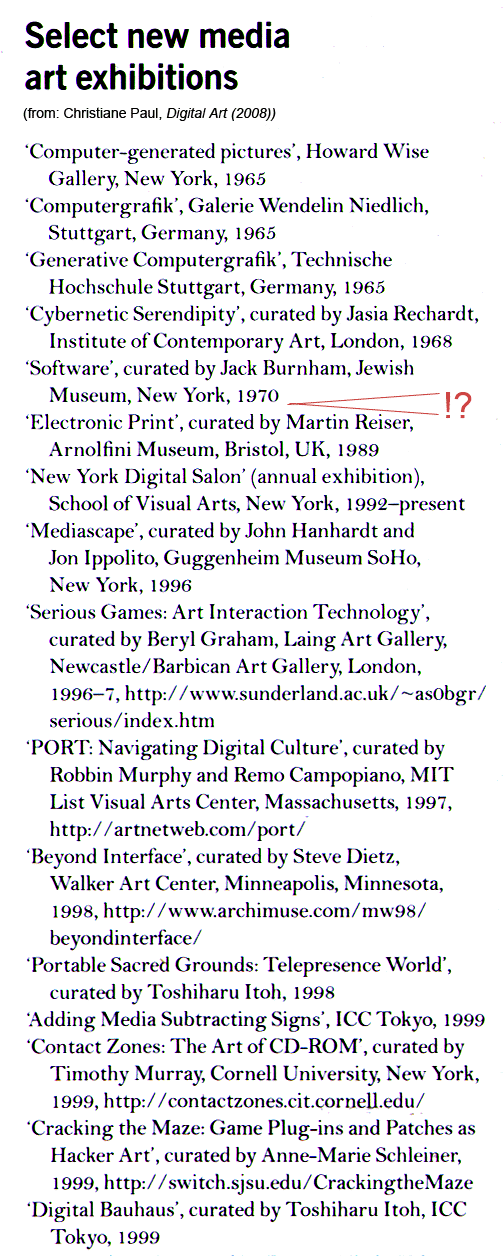
And as another little bit of evidence for this I noticed a significant lacuna in the listing of major shows in:
Paul, C. (2008). Digital art. Thames & Hudson.

Yup... it all (save two minor exceptions) drops out of existence between 1970 and 1996... Now we need to bear in mind that the author is only considering Digital art, and not all Art/Tech endeavors including most Audio or Sound art – which did carry a sputtering torch into the new century -- nor even (Analog) Video...but...but...

Just WTF happened here?

Stay Tuned!

(continue to Part 2: The Perfect Storm)