Zimoun : 36 ventilators, 4.7m3 packing chips, 2014 from STUDIO ZIMOUN on Vimeo.
Just as a reminder, my less popular installation from Sept 2012 can be seen here:
There is no doubt that this conjunction of the real and the virtual engendered by simulation is at the heart of present research by many technological artists. They consider that 'virtual space', 'virtual environments', or 'virtual realities' in general usher in an entirely new era in art, allowing the participants a multi-sensorial experience never encountered before.
The key words 'artificial intelligence' as an aesthetic problem open up a vast, time-worn discussion of the relationship between man and the machine. Artificial intelligence embraces techniques which enable machines, and in particular computers, to simulate human thought processes, particularly those of memory and deducation [sic].
In the past, a sculpture or painting had meaning only at the grace of the viewer. His projections into a piece of marble or canvas with particular configurations provided the programme and made them significant. Without his emotional and intellectual reactions, the material remained nothing but stone and fabric. The systems's programme, on the other hand, is absolutely independent of the viewer's mental participation. It remains autonomous -- aloof from the viewer. As a tree's programme is not touched by the emotions of lovers in its shadow, so the system's programme is untouched by the viewer's feelings and thoughts.
Naturally, also a system releases a gulf of subjective projections in the viewer. These projections, however, can be measured relative to the system's actual programme. Compared to traditional sculpture, it has become a partner of the viewer rather than being subjected to his whims. A system is not imagined; it is real.
Repetto, Douglas (2010).
Doing It Wrong.
(from the 2010 Symposium -- Frontiers of Engineering: Reports on Leading-Edge Engineering)
Although musical innovators throughout history would have articulated these ideas differently, I believe they shared the central tenets that creative acts require deviations from the norm and that creative progress is born not of optimization but of variance. More explicit contemporary engagement with these ideas leads one to the concept of creative research, of music making with goals and priorities that are different from those of their traditional precursors -- perhaps sonic friction, in addition to ear-pleasing consonances, for example, or "let’s see what happens" rather than "I’m going to tell you a story."
Postmodern science does, in fact, exist, and literature just may be it.
Mackey, J. L. (2006).
Is Chaos Theory Postmodern Science?
(in reconstruction: studies in contemporary culture, Jan 24, 2006)
Alexander, V. N. (2011).From the chapter 1:
The Biologist's Mistress: Rethinking Self-organization in Art, Literature, and Nature.
Emergent Publications.
What I do share with all teleologists, authentic or so-called, is a deeply felt folk-sense of purposefulness in nature. It is clear to me that many processes and patterns in nature can't be fully explained by Newton's laws or Darwin's mechanism of natural selection. These are processes that are organized in ways that spontaneously create, sustain and further that organization. Although I believe that mechanistic reductionism is inadequate to describe these processes, I don't believe that purposeful events and actions require guidance from the outside -- from divine plans or engineering deities. Nature's purposeful processes are self-organizing and inherently adaptive, which is the essence of what it is to be teleological.
Johnston, J. (2008).From the preface:
The allure of machinic life: cybernetics, artificial life, and the new AI.
MIT Press.
This book explores a single topic: the creation of new forms of "machinic life" in cybernetics, artificial life (ALife), and artificial intelligence (AI). By machinic life I mean the forms of nascent life that have been made to emerge in and through technical interactions in human-constructed environments. Thus the webs of connection that sustain machinic life are material (or virtual) but not directly of the natural world. Although automata such as the eighteenth-century clockwork dolls and other figures can be seen as precursors, the first forms of machinic life appeared in the ‘‘lifelike’’ machines of the cyberneticists and in the early programs and robots of AI. Machinic life, unlike earlier mechanical forms, has a capacity to alter itself and to respond dynamically to changing situations.
McCormack, J., & Dorin, A. (2001, January).
Art, emergence, and the computational sublime.
In Proceedings of Second Iteration:
A Conference on Generative Systems in the Electronic Arts.
Melbourne: CEMA (pp. 67-81).
In a design sense, it is possible to make creative systems that exhibit emergent properties beyond the designer's conscious intentions, hence creating an artefact, process, or system that is "more" than was conceived by the designer. This is not unique to computer-based design, but it offers an important glimpse into the possible usefulness of such design techniques -- "letting go of control" as an alternative to the functionalist, user-centred modes of design. Nature can be seen as a complex system that can be loosely transferred to the process of design, with the hope that human poiesis may somehow obtain the elements of physis so revered in the design world. Mimicry of natural processes with a view to emulation, while possibly sufficient for novel design, does not alone necessarily translate as effective methodology for art however.
Penny, Simon (2009).
Art and Artificial Life a Primer.
4.1 An Aesthetics of Behavior
With the access to computing, some artists recognized that here was a technology which permitted the modeling of behavior. Behavior - action in and with respect to the world - was a quality which was now amenable to design and aesthetic decision-making. Artificial Life presented the titillating possibility of computer based behavior which went beyond simple tit-for-tat interaction, beyond hyper-links and look-up tables of pre-programmed responses to possible inputs, even beyond AI based inference -- to quasi-biological conceptions of machines, or groups of machines that adapted to each other and to changes in their environment in potentially unexpected, emergent and ‘creative’ ways.
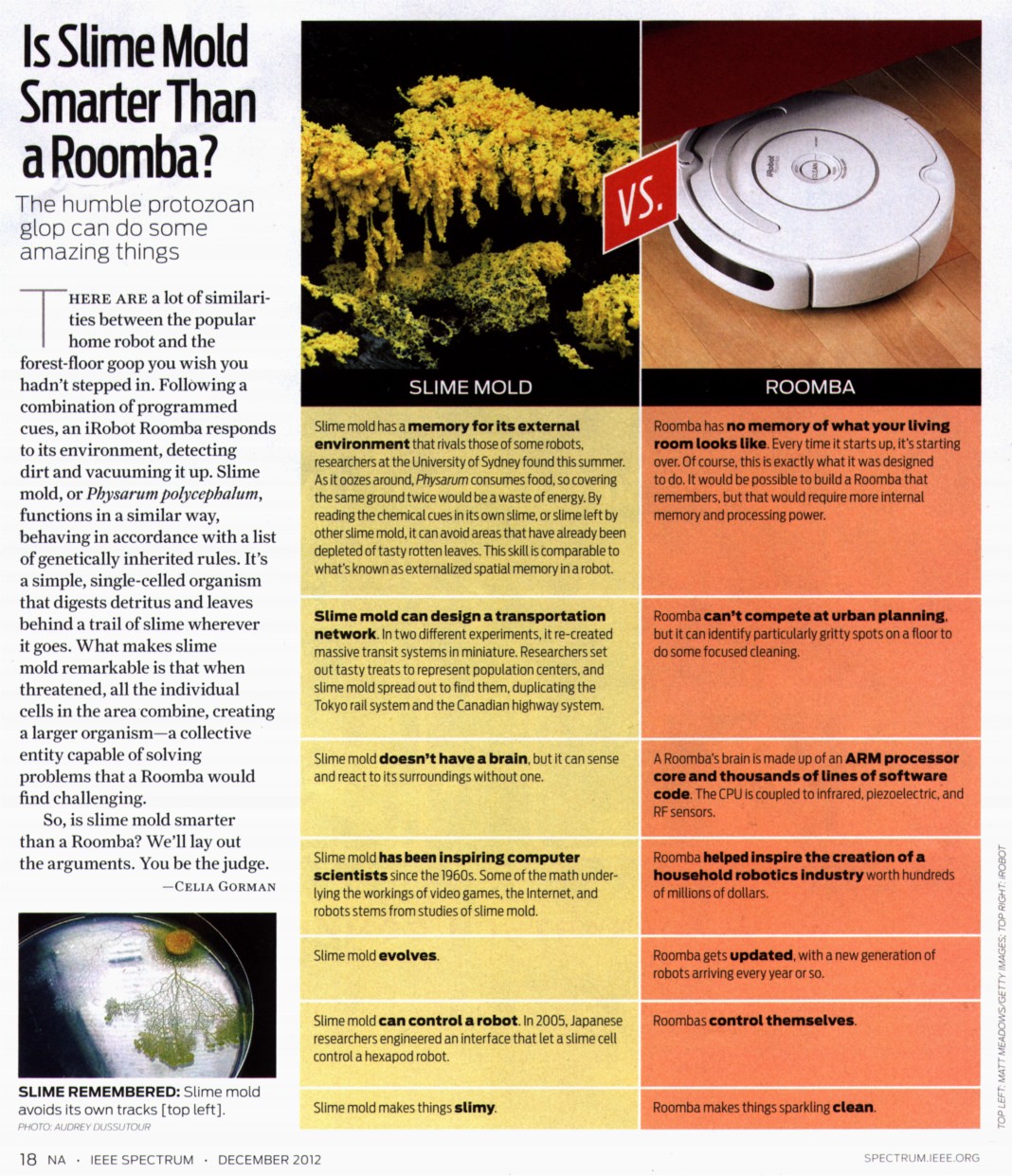 |
| Is Slime Mold Smarter Than a Roomba? IEEE Spectrum (December 2012) |
Within a generation ... the problem of creating 'artificial intelligence' will substantially be solved.But by the early 1980s rule based Expert Systems -- which seem to be inherently fragile -- were the main success story.
Minsky (1967), Computation: Finite and Infinite Machines, Englewood Cliffs, N.J.: Prentice-Hall (p. 2)
Voegelin, S. (2010). Listening to noise and silence: Towards a philosophy of sound art. Continuum.And that's the (cherry picked) Reformed Standard Version talking...It does mean something, but could surely have been expressed more clearly.
In this sense postmodernism is to modernism the noise of heterogeneity, working outside and across disciplines, squandering its systematic valuation in decadent centrifugality. The postmodern is a radicalization of the modernist understanding of the artwork.
Sokal, A., & Bricmont, J. (1999). Fashionable nonsense: Postmodern intellectuals' abuse of science. Picador.
Ascott, R. (1966). Behaviourist Art and the Cybernetic Vision. Cybernetica, Journal of the International Association for Cybernetics (Namur), 9.
Fundamentally Cybernetics concerns the idea of the perfectibility of systems; it is concerned in practice with the procurement of effective action by means of self-organising systems. It recognises the idea of the perfectibility of Man, of the possibility of further evolution in the biological and social sphere. In this it shares its optimism with Molecular Biology. Bio-cybernetics, the simulation of living processes, genetic manipulation, the behavioural sciences, automatic environments, together constitute an understanding of the human being which calls for and will in time produce new human values and a new morality.
MacGregor, B. (2002, October). Cybernetic serendipity revisited. In Proceedings of the 4th conference on Creativity & cognition (pp. 11-13). ACM.
Burnham, J. (1968). Systems Esthetics. Artforum, 7(1), 30-35.From the article:
The systems approach goes beyond a concern with staged environments and happenings; it deals in a revolutionary fashion with the larger problem of boundary concepts. In systems perspective there are no contrived confines such as the theater proscenium or picture frame. Conceptual focus rather than material limits define the system. Thus any situation, either in or outside the context of art, may be designed and judged as a system. Inasmuch as a system may contain people, ideas, messages, atmospheric conditions, power sources, and so on, a system is, to quote the systems biologist, Ludwig von Bertalanffy, a "complex of components in interaction," comprised of material, energy, and information in various degrees of organization. In evaluating systems the artist is a perspectivist considering goals, boundaries, structure, input, output, and related activity inside and outside the system. Where the object almost always has a fixed shape and boundaries, the consistency of a system may be altered in time and space, its behavior determined both by external conditions and its mechanisms of control.Developing the above in 1970, he published this essay in a collection of papers titled On the Future of Art, edited by Arnold Toynbee under the auspices of the Guggenheim Museum:
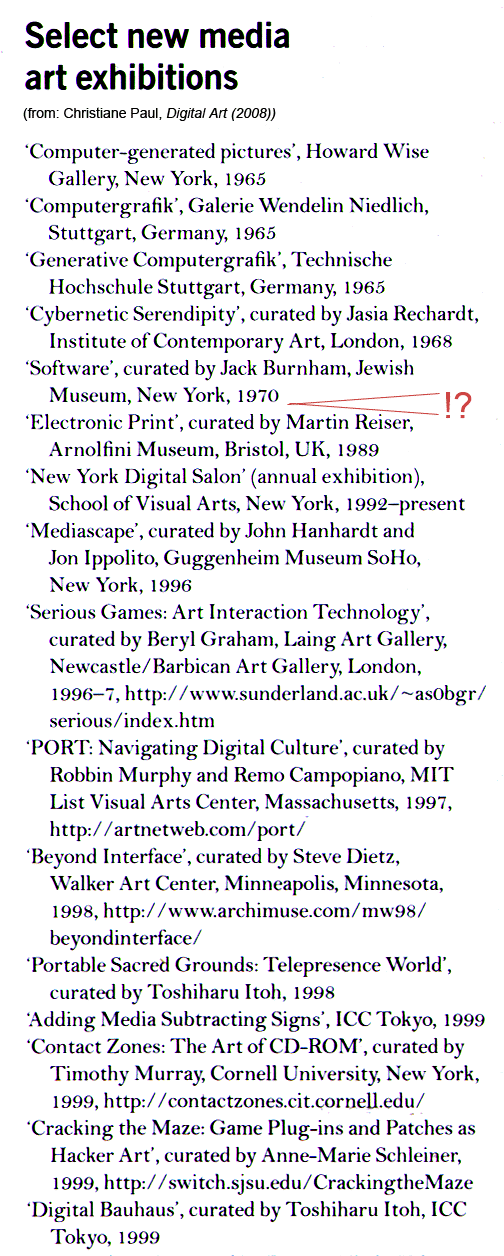
Burnham, J. (1970). The Aesthetics of Intelligent Systems.And later that year he curated the Software show at the Jewish Museum in NYC, which illustrated many of these ideas using a broad range of technological and conceptual art practices. You can find catalog excerpts here: Software. Unfortunately this show was a near-complete disaster on both technical and social grounds, and has more-or-less disappeared from view. It was supposed to travel to the Smithsonian in Washington, DC, but circumstances (a fire at the Smithsonian) intervened and saved everyone the embarrassment. Aside from its disastrous run, Software presented a view of the state-of-the-art-in-technology-and-concept that may never be repeated.
Burnham, J. (1968). Beyond modern sculpture: the effects of science and technology on the sculpture of this century. G. Braziller.
The last chapter of which you can steal here: The Future of Responsive Systems in Art
Benthall, J. (1972). Science and technology in art today. Thames and Hudson.
Which still appears to be available used and reads as pretty much contemporary. The point to which I'm circuitously trying to get around to here...
[coined by Norbert Wiener in 1948] as "the scientific study of control and communication in the animal and the machine." Cybernetics from the Greek meaning to "steer" or "navigate." Contemporary cybernetics began as an interdisciplinary study connecting the fields of control systems, electrical network theory, mechanical engineering, logic modeling, evolutionary biology, neuroscience, anthropology, and psychology in the 1940s, often attributed to the Macy Conferences. During the second half of the 20th century cybernetics evolved in ways that distinguish first-order cybernetics (about observed systems) from second-order cybernetics (about observing systems). More recently there is talk about a third-order cybernetics (doing in ways that embraces first and second-order).Here are a couple other good resources to get a handle on:
Paul Pangaro's "Getting Started" Guide to CyberneticsAnd a really thorough but succinct description of the players and fields involved:
Ben-Ali, F. M. (2007). A History of Systemic and Cybernetic Thought From Homeostasis to the Teardrop.
Shannon, C. E. (1948). A mathematical theory of communication. The Bell System Technical Journal, Vol. 27Artists, especially of the Conceptual variety, glommed-on to these ideas and did what they usually do, jump to conclusions... Here's an excerpt from a review of:
Moles, A. (1968). Information theory and esthetic perception. Trans. JE Cohen.
Let us consider perception by an individual human being as communication from the external world to that human, says Moles, now a professor of philosophy in Strasbourg. Let us consider in detail artistic communications, since it is particularly easy to isolate them. Then esthetic perception, as a special kind of communication, should be amenable to analysis by information theory, Moles concludes, since information theory is a mathematical theory of communication.Using the above as corroboration, My Humble Opinion is that the most egregious excesses of Conceptual Art, where Art is reduced to Information, result from this sort of mis-reading of Shannon as having something to say about Meaning. For a little more detail have a look at the links on my page: Shannon's Information Increased
This reasoning is an example of what philosophers call the fallacy of equivocation: what Shannon and Wiener, inventors of information theory, meant by "communication" is not what Moles has in mind...
Shanken, E., Clarke, I. B., & Henderson, L. D. (2002). Cybernetics and Art: Cultural Convergence in the 1960s. From Energy to Information.
Moving away from the notion of art as constituted in autonomous objects, Ascott redefined art as a cybernetic system comprised of a network of feedback loops. He conceived of art as but one member in a family of interconnected feedback loops in the cultural sphere, and he thought of culture as itself just one set of processes in a larger network of social relations. In this way, Ascott integrated cybernetics into aesthetics to theorize the relationship between art and society in terms of the interactive flow of information and behavior through a network of interconnected processes and systems.But in the abstract of another paper, Shanken indicates that Cybernetic Art got entangled with Conceptual Art and the Technology component was dropped like a hot potato:
Shanken, E. A. (2002). Art in the information age: Technology and conceptual art. Leonardo, 35(4), 433-438.
Art historians have generally drawn sharp distinctions between conceptual art and art-and-technology. ... By interpreting conceptual art and art-and-technology as reflections and constituents of broad cultural transformations during the information age, the author concludes that the two tendencies share important similarities, and that this common ground offers useful insights into late-20th-century art.
And as another little bit of evidence for this I noticed a significant lacuna in the listing of major shows in:Burnham, J. (1979). Art & Technology, the Panacea that Failed. The Myths of Information, ed. Kathleen Woodward, Coda Press
Paul, C. (2008). Digital art. Thames & Hudson.
Born, Georgina
Rationalizing Culture -- IRCAM, Boulez, and the Institutionalization of the Musical Avant Garde
1995, University of California Press

What began in this century as a utopian and vaguely Romantic passion, namely that technology offered an opportunity to expand human perception and provide new avenues for the discovery of reality, subsequently evolved through the 1960's into an intoxication with this humanistic agenda as a social critique and counter-cultural movement. The irony is that many of the artist's who were most concerned with technology as a counter-cultural social critique built tools that ultimately became the resources for an industrial movement that in large part eradicated their ideological concerns. Most of these artists and their work have fallen into the anonymous cracks of a consumer culture that now regards their experimentation merely as inherited technical R & D. While the mass distribution of the electronic means of musical production appears to be an egalitarian success, as a worst case scenario it may also signify the suffocation of the modernist dream at the hands of industrial profiteering.

