Tuesday, October 2, 2012

Turbulence -- Day of Reckoning

So it's all over but the documenting. My Axle installation has been deconstructed:

AfterMath

Even if it didn't make manifest all the hoped for effects, kids loved it. Adults had more reserved reactions, like, "So that's where packing pellets go to die". And there are some lessons learned.

First, as I should have known from my Exploratorium days, those darned kids will destroy everything:
Road Warrior
On the plus side, I got to use the Holy Trinity of Bricollage: duct tape, bailing wire, and Goop.

Second, the pellets slowly destruct and get into everything:
Stuff Everywhere

So if it was to be a more permanent installation there needs to be an easy way to clean it out.

Third, the critical angle of the pellets I used is just about 30°. This is just about what I used for the backing ramp, except that the truck got parked at various angles every day. And there was an intentional, but not entirely functional, lip right at the end of the ramp which (I think) provided too much resistance:
The Lip Problem

Due to the variable angles sometimes things flowed too freely and other times not quite at all. Unfortunately the last two days, at Harry's Roadhouse and the Children's Museum, were down-slope days so there was not much pellet action after things got settled. Ah well...

Fourth, the pellets didn't really circulate through the length of the truck. They mostly blew up and then fell back down near the window and fans. I should have put a deflector at the top of the window to encourage full-flow behavior.

Fifth, the whole Moody Interactive Thing didn't really come off. It took too much observation and was probably too subtle to observe. I erred on the side of making sure something would happen no matter what so as to avoid getting the, "Stupid Shit's Broken As Usual" response. This was probably a good choice overall...


Play it Again Sam?


Maybe. I could see putting this into the corner of a room with a glass wall in front. Given a stable setting the angle management and flow behavior could be improved. I would also paint the space black and use white pellets -- I considered this for Axle but didn't want to de-gallerize their space, maybe I'm too timid? The whole pastel thing, while raising the New Mexico State Question, "Red or Green?", was a little too, well, pastel for my taste.

I've got the fans if someone's got the room...

Monday, October 1, 2012

Conceptual Framing

Recently I've been to two shows here in Santa Fe where the signs are better than the work itself. ...I am of course overstating things -- there are pieces in each show that, with a push, could stand on their own...

The first show, More Real? Art in the Age of Truthiness at SITE Santa Fe, has room after room of stuff that needs explaining. Now, all Modern and Contemporary art (and maybe all art in general) needs a little background to appreciate it appropriately -- just look to Duchamp. However the stuff that sticks with me has a visceral component that is amplified by the explanation, not the other way around. My feeling about the SITE show is that they should have kept the signs and dispensed with the work.

This lack of grounding is the fundamental problem of Conceptual Art, and probably the reason that almost every artist described in the book Conceptual Art (Ursula Meyer, 1972) -- which has been an interesting re-read after all this time -- has returned to making objects again.

An exemplar is the giant-trailer-skeleton-in-the-dim-room piece (IƱigo Manglano-Ovalle, Phantom Truck, 2007). You have to work at figuring out what it is if you have the patience to let your eyes adjust to the gloom. Or you can read the sign to find that it is a model of the hypothesized Iraqi mobile chemical weapons factories that were never found. Bada-Bing! No trucks were necessary to the making of this realization!

Nor did we get a mention of Baudrillard's Simulacra in the lengthy windup.

The second show, Dust in the Machine at the Center for Contemporary Art, follows conceptual suit but at least has some intrinsically interesting pieces. Such old hat as nicely done architectural photographs and simple video projections play well. But the attempts to make a statement -- a tar-pot-trailer-devoid-of-that-new-tar-smell parked in the middle of the space (?!) -- need those lengthy signs, which are missing, to get.

Maybe it's just the use of trailers indoors that frustrates me? I dunno...

Anyway. Since Santa Fe is all about the Light I need to come up with a proposal for CCA to actually use those Munoz-Waxman Gallery windows. Every show I've seen there goes out of its way to prevent that wonderful illumination from permeating the space.

Sunday, September 23, 2012

There might be an App for That

Another modest proposal for someone to implement:

Everyone I know has a preferred communication medium. I rather like email, even though I understand that it is considered rather declasse these days. One of my friends will only use TXT. Another is a master of the telephone, to the point that he has memorized everyone's numbers. Then there's FacePlant, Twitter, and FSM-knows what else.

So my killer-app suggestion is a program which converts your favorite medium to theirs and back.  I could send an email, friend A gets a TXT, and should she see fit to reply, I get an email back. For the phone one needs speech synthesis and recognition. Skype might need some canned video. Etc. Etal.

The App can even be extended for folks who refuse to use any electronic medium. My email could be handwritten and delivered with my calling card by a butler who would take the reply and email it back to me.

There are some impedance matching issues. For instance, the ideal phone call is an immediate back-and-forth coming to the point fairly quickly, and you can't really do that with TXT. But I'm sure someone smarter than me can work out all these details.

Surely there's an HTML5 guru out there who can run with this?

Friday, September 14, 2012

It Lives!!

Loaded it up and delivered it to its rightful owner/operators:


See it near the water tower at the Railyard on Sunday Sept 16, 2012.

Thursday, September 13, 2012

Experiencing the Install

Got the truck outfitted:
click for more

Still need to find a level place to stand in order to see if it really works.
More Anon.

Wednesday, September 12, 2012

Turbulent Hans Haacke

Last Saturday I went to the New York New Museum's Ghosts in the Machine show and found that Hans Haacke has already done it all. In 1965. On show were two of his pieces using wind blowers to move objects around in much more mesmerizing ways than my packing pellets.

http://mlkshk.com/r/4WH6

The first, Blue Sail is a big, well not to put too fine a point on it, blue sail of light fabric tethered and weighted at the corners. A household variety oscillating fan underneath makes it billow and flow in apparently random ways. The second, Kugel in Schragen Luftstrahl, is a small helium weather balloon bobbing around in the mid-air Bernoulli effect of a hairdryer blower. When the guard wasn't looking I waved my hand over the blower outlet and got it to bobble even more. Way nicer, and quieter, than the volley-ball-in-traffic-cone version we had at the Explo, which, while doing all this putzing around, I didn't think of either.

Fortunately no one knows about Haacke and his hot air, aside from the hundreds of tourists that go to NYC Museums, so I may be safe.


http://www.artnet.com/Magazine/features/cone/Images/cone8-6-11.jpg
Right next to Haacke's balloon was a piece by Gunther Uecker called New York Dancer IV -- also from bloody 1965. A human sized shroud of canvas pierced through all over with various sizes of iron nails. It just hung around until 4pm when I was lucky enough to stumble into the room in time for it's daily demo. A stunningly gorgeous young woman came darting into the space, uncovered a red switch-box in the corner, meticulously donned cotton curatorial gloves, and with a fairly bored expression pushed the button to make the thing slowly spin. As it got up to speed the fabric billowed out and the nails flailed around in pleasant wavy ways. Then some bit would get bound up in the mechanism causing the whole thing to slam crashing around, at which point our Muse let off the gas for a bit to slow it down. And...Repeat.

<sorry...no photo>

Grasping for a conversational gambit afterwards, I asked her if it had been the artist's intention to have those transitions from simple waving to complex crashing. She said he had actually demonstrated it being operated as such, although she described it as, "Really stomping on the switch..." So it's not entirely clear if complex behavioral transitions were a consciously desired result or just serendipity.

The rest of the show was a mixed bag of mechanical objects and mechanical drawings, all owing their raison to Duchamp's Bachelors -- if one is to believe the curatorial introduction in the catalog. Much of it was fascinating historically and some was still engaging. However, while there was a bit of work from the post-1970's, it stopped short of the Software show debacle and Burnham's subsequent Panacea that Failed analysis of the whole ArtTech scene. This may, by its absence, provide another leg for my hypothesis -- that all we got out of the era was MTV -- to stand upon.

Anyway....I get the Axle truck in about an hour to start the actual installation...

Tuesday, August 21, 2012

Turbulent Software

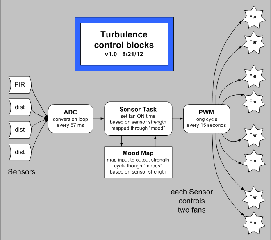
The control system and software work about as well as they are going to. I get the truck on Sept 12 to see just how good that is:
System Block Diagram

 We hope to go live before the Sept 16 After Dark party in Santa Fe's Railyard. I will also have two "studies" in the ISEA Residencies show at the UNM Architecture Gallery. The opening is Sept 22 (I think). Schedule to follow.