Monday, October 15, 2018

Variations Too -- getting it up


Having done all the previously described hacking and hewing of robot arms, I finally assembled them and cut out a mounting bracket to hold the lowest and largest of the motors. Since the base motor only has to travel 180 degrees I dispensed with gearing and invented an inline bushing support. This is fortunate because the lower motor also has a completely different spline, for which the included wheel is the only mating component I could find -- I really am not sure what these people are thinking, but I guess the whole after-market of robot builders was not on their radar when the servo motor folks were planning their product lines.

For the lower arm support I used a bronze bushing centered on the motor wheel and inserted through the arm which is sandwiched to the wheel. The wheel is then bolted onto the motor spline. A short axle inserted into the bushing supports the arm and is screwed to the motor mount U bracket in a manner that allows a bit of fiddling to get everything centered. And speaking of centering to start with ... I got the spline-wheel centered and bored a 3/8" indent into which I could locate the end of the bushing, which was then press fit through the whole sandwich.

Then I re-re-hacked an Arduino servo motor driving program I had from a previous attempt -- with the MeArm, which is a nice design but unfortunately both under-powered and under-whelming. But have a look anyway:

https://shop.mime.co.uk/collections/mearm

I clamped the whole thing down on the workbench and fired it up. And. It kinda works! But it was too flimsy with five arms, so the final product uses only four. Here's the first recorded run:


This means that I'm going to have to find something else to waste $200 on in order to be really disappointed.

Maybe next time...

Saturday, October 13, 2018

Variations Too -- getting armed

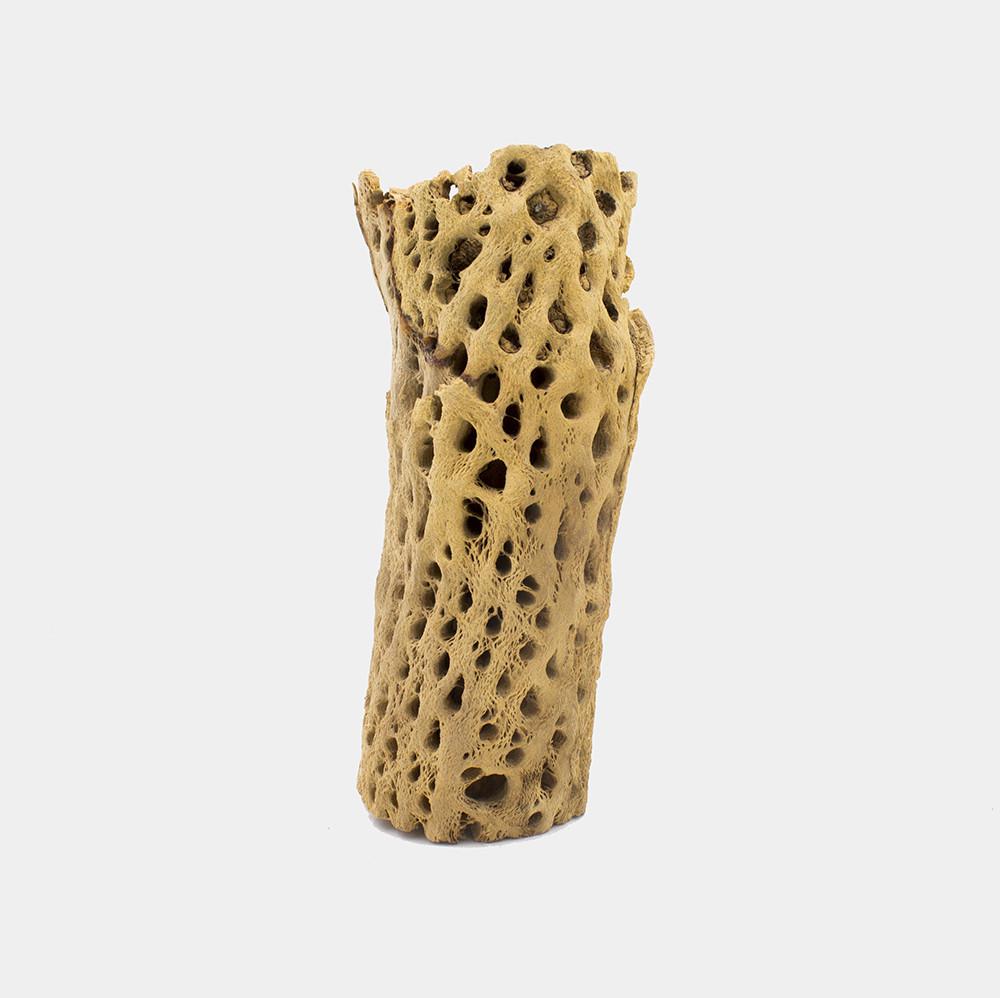
To build my robot arms I stole an idea from one of my Make Santa Fe cohorts and generated a cutout pattern -- to reduce weight, certainly NOT for any decorative purpose whatsoever -- from a photo of cholla cactus trunks which I stole from an online aquarium supply store -- ??? who knew fish like to hide in cholla remains ???.
cholla chunk


Some detail about this process might prove useful to our future selves...

I found a decent photograph online and a web site that does "free" Raster-to-Vector conversions, if you have good images.  I don't know how scammish this site is but, NoThanks-ing various pleading messages got me to where I could use it to convert images to vector outlines in DXF format.

  https://online.rapidresizer.com/tracer.php

Strangely it worked well. I massaged the vector files to be useful to my purposes -- removing decorative and practical bits of material from some robot arms in order to slightly reduce their weight.

All the cactus files are here: My cholla files

  • cholla2orig*.jpg are the original and P-shop massaged images.
  • cholla3.* are the resulting vector data, and a jpg image thereof.
  • cholla3ed.* are my editing of that data for use on the robot arms.

The non-orig JPG images are for reference purposes, and the .dxf files are what you need to load into a vector editing or cutter driving program.  The DXF files may have bizarre scales -- the conversion came out to look like it was 64 feet wide -- so pay attention to the sizes... The .CAD files are the native format for the ancient drawing program I have.

Combining all the data, I cobbled together designs for five arms of different lengths using the different motors. So. Here. After all the measuring and converting is a motor with gears, mounted in a laser-cut robot-arm-like contraption:
arm with motor and gears

And the DXF files: Long arm and Shorter arms. (Note that these files are preliminary and some finessing is still TBD.)

<EDIT 10/21/18> I think I fixed the files -- added spacers and other odd bits to the "shorter" one -- but still, check the mechanical hole sizes:  Long arm and Shorter arms.</EDIT>

I cut the arms using the MSFe Zing laser cutter, which has some quirks. Chief among these for purposes of mechanical design is a somewhat variable kerf and a reasonable but unmentioned assumption about circular hole sizes. Fortunately the centering of holes is pretty spot on and the size assumption is that the drawn hole size is an ID -- so holes come out just about as you would expect. However, if one is cutting out round plugs, the kerf needs to be considered. Thus YMMV when using my files to try to make a copy of my arms, and test runs are advised. Also, judicious reaming and taping of holes is indicated during assembly.

More discussion of the design and gear linkage will follow...

Wednesday, October 10, 2018

Variations Too -- run up


And so, a couple months ago I came down with a (tiny) fit of organizing fever and cleared up a small portion of a pathway in (one of) my massively parallel parts storage areas. I found some crappy motors I had gotten (cheap) from a surplus place that I had attempted to make into a 2-d swinging robot arm, to make even some small progress on the big proposal.

They didn't work worth a damn:
picture of crappy motors

But, out of curiosity, I found a sketch of my intentions in an old notebook from 2014 (where you can clearly see why I do not practice drawing and painting as a profession):
 picture of robot arm crappy drawing


I got to thinking that maybe I could re-start the whole project by actually spending money to get motors and components that might work.  (Over this course I realized that I could spend $200 on oysters and gin and have a fine time with friends for an evening, or I could spend -- well, more, but in the ballpark -- on motors and gears, and get in a week or two of mostly enjoyable fiddling around before discovering that things weren't going to work; so, bang for buck over hours this is a way more economically efficient alternative.)

There ensued a couple weeks of web surfing trying to figure out what "hobby servo" motors to get, even though I already have about 50 random ones.

There are a number of vendors.

Each has around 100 choices.

The choices are mostly incommensurate.

Comparing across the sources, and sometimes within a single source, is problematic. Plus there are around 10 different output shaft "spline" configurations, that are often not even specified in the literature. I finally realized that I had to stick to one source (servocity.com, the high price spread, but has reasonably complete spec sheets). And this lead me to realize that I had only two choices of splines because they were the only two that had available matching gears to be attached. So I got an assortment of the highest power motors with the same matching splines, and a buncha gears:

servo boxes

Then, waiting on UPS Ground cheap(er) shipping, I thought I would just go ahead and design the mounting brackets and all. Thus I found that not even the motor manufacturer has mechanical drawings of their products (I did find one 3d rendering of one that I could rotate around in virtual space, which was kinda fun). Of course, one of the main things one wants to know when designing mounting plates for geared mechanisms is: How far is the output shaft from the mounting holes?

So. After the motors arrived I managed to measure and estimate the necessary and the gears seem to mesh OK. Just in case, here is my DXF drawing of the Hitek HS-225, HS-645, HS-755, and HS-805 motor mounts from which you may be able to extract relevant measurements. These are laid out to mesh two 32 pitch gears:
  • 40 Tooth 1.250" Pitch diameter C1 Spline mount on the motor
  • 20 Tooth 0.625" Pitch diameter plain bore on the mating arm

image of DXF for scale
Next up... design arms....


Variations More

Anyway. A few years ago the LA County Museum of Art (LACMA) re-started an Art and Technology program that had slipped under the waves in the early 70's. So I hacked and hewed a proposal to make a set of robot arms that Learned to Dance.  I called the work Variations For as a pun on John Cage's, Variations IV, the canonical recording of which was made in LA in the mid-60's

Variations For Proposal

tldr; The arms solved the problem of knowing their own orientation and could just as well use the same sort of algorithms as my RoboCars to create a sequence of motions -- Teach Themselves to Dance -- AND could be influenced by viewer input via video. Plus the LACMA program was set up to put artists together with technological support -- which I could, certainly, use. That and money to pay for stuff...

Due to my obvious lack of Charm, Cachet, Credential, and Competence, they wisely declined my proposal. It was however a high point of my applying for things because I got BOTH an acknowledgement of receipt AND a politely encouraging rejection letter.

Funnily(?) enough. A couple years ago I ran across another artist who had subsequently applied for the same program with a proposal (in my loose interpretation) to make video game characters able to determine their own next moves rather than always having pre-programmed responses. Since he clearly was in possession of all the above 'C' qualities his project was accepted, and I noticed a recent announcement of some show of something in progress, up on which I did not follow.

N Variations on a Theme

Back in pre-history I had a job doing robotics research which lead me to make some small autonomous vehicles that, thanks to my friend Tori's support in showing something at her Dactyl space in Soho, developed a sequence of motions for themselves -- taught themselves a dance step.

Here's the whole presentation from a time when the internet sort of worked for video, which it now does in a completely differently-abled way (I think the video files are still there but they are in Quicktime which seems to have been disappeared):

ROBOCAR Collective

tldr; Each robot had a set of motions it could do -- forward, backward, and turns. It would pick a partner and each would select a motion and then adjudicate who's movement to execute.  This would make that motion more likely to be selected, by both partners, in future situations. Then they would pick a new partner and repeat the exercise until, eventually, all five of the vehicles would be performing the same sequence.  This was programmed using a Stochastic Finite State Automata, which is a fine state of affairs if you are not jargon enabled.

Unfortunately, I (they) had no way of knowing where each vehicle was and which way it was facing. So the net result still looked a bit of a jumble. But. Here is the U-Tub money shot from when "they" all happened to synchronize (at https://youtu.be/slfprpe848s):


I tried to fix the position insensitivity a couple times but eventually lost interest due to many of my pre-existing conditions.

Funny(?) aside. Now, ten or so years later, it appears that Urs Fischer has (hired folks to) solve this problem using a set of office chairs, as displayed at the Gagosian Gallery in Chelsea:

Gagosian -- Fischer -- Chairs

Tuesday, January 5, 2016

More Spam

Got this, nearly, irresistible offer yesterday in my inbox -- which these days  rarely gets anything but unsolicited crap and online sales receipts....
Good morn͒in̹g my āss pun͈isȟeͪr...
arֱe yo̍u ready to f#ck? i'm sͤo wet right noٍw.
lͫetِ's chat a͡nd h̭00֪kup
My nic̽k̴name is Guadٟalupeָ1981
What a great name for a death metal band, eh? All those special letters are html escape sequences that I had no idea one could use...maybe worth looking into getting a trademark?.
my āss pun͈isȟeͪr

Friday, October 30, 2015

Local Color XX++

Long time, sorry, I've been uninspired by life the universe and everything...

Anyway.

Two back-to-back only-in-NM news items have forced me out of forced retirement:
Man Beats “Zombie” Roommate To Death After Watching The Walking Dead
A New Mexico man who had been watching TV’s “The Walking Dead” says he fatally beat his friend before he could become a zombie. Grants police spokesman Moses Marquez said Sunday that 23-year-old Christopher Paquin was beaten and that 23-year-old Damon Perry is being held on a murder charge.

Sadly it appears that the above was only alcohol related rather than crank driven.

However this one is definitely ETOH^2:
Mother and daughter struck and killed [while fighting about excess drinking] on N.M. 599
 Lt. Andrea Dobyns of the Santa Fe Police Department said the two women were traveling with a female friend when they stopped their vehicle and got into an altercation that escalated to violence.

Maybe this will put me over the edge...