Monday, November 26, 2012

Modes of Inquiry

In recent discussions about the respective roles of Art and Science in our culture I keep running up against He-Said/She-Said sorts of arguments about how each camp works. The first problem is that many people don't seem to have a clue about how anyone else actually works, so you get blanket statements like, "As a scientist, how can you claim to be creative when all you do is work with data?" Following from that, the second problem is that the putative categories are presented as being somehow Black and White rather than subtly shaded. And a third problem is that there are more than two categories... To which point I post this diagram:
Tetrahedron of Reality
As a starting point I calve Engineering from Science (the oft mis-identified Technology) -- and Art -- and then add Philosophy as a separate discipline. Each of these nodal points is a particular mode of inquiry into the working of the world with its own processes, methods, and results. However, in practice, none of them are pure. As the impurest of the impure I put a little bricoleur bouncing around inside the space as needed or -- more likely -- at random.

I probably should include a node for Society, i.e., politics, economics, and social manipulation/persuasion, but A) I don't understand them; and, B) I can't draw a 5-space collapsed into two dimensions. Which is probably too bad because without Society you can't really do anything in the other modes modulo a trust fund. But so it goes.

In the spirit of twentieth-century management-think I also posit a set of cross-cutting dichotomies:
  • Process -- Rational or Empirical (using the Cartesian meaning of both);
  • Methods -- Logical or Fanciful (there must be a better opposite, no?);
  • Results -- Theoretical or Physical (i.e., in the mind or in the world);
  • Product -- Useful or Ephemeral (a practical thing or an entertaining idea?).
So one could have a Rational Process using Fanciful Methods with a Theoretical Result whose Product is Ephemeral, which might be a novel or most of post-modern philosophy. Or an Empirical Process using Logical Methods with a Physical Result whose Product is Useful, and get an iPhone. Maybe. Or change the Result to Theoretical and end up with the Large Hadron Collider...

Being grey areas, none of the modes has a lock on any particular set of cross-cuts, although some may be more likely candidates than others. I'm having a hard time imagining a Rational, Fanciful, Theoretical, Ephemeral Engineering project ... But that might be something for our bricoleur to try, eh?

Since the probability of anyone actually reading this is approximately 1::109 (one in one-billion), which is a factor of ten less likely than winning the lottery, I guess it doesn't matter. But if you made it this far, as an Empirical, Fanciful, Theoretical, & Ephemeral experiment, click one of the little Reactions buttons down there so I know you were here.

Sunday, November 11, 2012

Born Rationalizing Culture California

Although it sounds like a genetic-predisposition/lifestyle-choice it is also an actual bibliographic reference:

Born, Georgina
Rationalizing Culture -- IRCAM, Boulez, and the Institutionalization of the Musical Avant Garde
1995, University of California Press

If you still don't believe me here is a scan of the binding, which is why I kept it on my bookshelf for so long while making only half-hearted attempts at reading it:


In the course of purging post-modernism from my collection I figured that I could at least force myself through the conclusion section. As a result I may keep it a bit longer, or else send it to Sudhu as mulch for his electronic ethno-musicology dissertation.

The first interesting thing is that IRCAM was founded in 1977 and funded by the French government. The second thing is that is was meant to be an Art/Science research facility. The third thing is that it was a rather stratified environment: Composers, who supposedly knew -- but often didn't recognize -- the stuff they wanted to do were always superior to Tutors, who actually knew how to do the stuff. And the fourth thing is that it looks like this Institutionalization took the wind out of the sails of the Avant Garde that it was supposed to bolster.

That last point may be reaching -- in order to support my own thesis that everything went to hell in the '70's -- but there it is.

To add more support I quote from David Dunn's A History of Electronic Music Pioneers, which was published in the catalog for the 1992 Eigenwelt der Apparate-welt show of electronic artists. He valorizes the '60's composers whom we all know and love for being in a sweet spot of technical and aesthetic development, then asserts that it was all co-opted:

What began in this century as a utopian and vaguely Romantic passion, namely that technology offered an opportunity to expand human perception and provide new avenues for the discovery of reality, subsequently evolved through the 1960's into an intoxication with this humanistic agenda as a social critique and counter-cultural movement. The irony is that many of the artist's who were most concerned with technology as a counter-cultural social critique built tools that ultimately became the resources for an industrial movement that in large part eradicated their ideological concerns. Most of these artists and their work have fallen into the anonymous cracks of a consumer culture that now regards their experimentation merely as inherited technical R & D. While the mass distribution of the electronic means of musical production appears to be an egalitarian success, as a worst case scenario it may also signify the suffocation of the modernist dream at the hands of industrial profiteering.

Friday, November 9, 2012

Gene - Meme - Beam
a parable

A random network of chemicals, when pumped with enough volcanic vent effluent, forms an energy storage system. Voila, the Krebs Cycle!

Little bags from around those chemicals and some more complicated molecules take charge of passing the information along to the next generation. What's in your Genes?

Some of the little bags aggregate into foraging things and develop ways of cooperating with other aggregates in order to hunt and gather more efficiently. We get Language.

Using language to pass along the best solutions to various feeding problems we humans take over the planet. Cities beget Memes.

Larger and larger cities need more and more energy. The Industrial Revolution comes out of the closet. Resources are devoured.

People use the extra energy to store their memes in clouds so they can be accessed from anywhere. It's all Beams!

The electrical grid fails and with the server-farm diesel-generators' last gasp all the clouds disappear.

-- pffffttt --

Sunday, November 4, 2012

Final Trip Report

As I mentioned in a previous report, in late October I visited a number of Holy Shrines in the Bay Area. Here's the second half of my itinerary.

Start with pre-Halloween festivities at Orchard Supply Hardware with Ken, where one can still purchase many lengths of 2-52 nuts and bolts, in contrast to my local Ace Hardware where I'm lucky to find anything smaller than a miniscule selection of 4-40's...
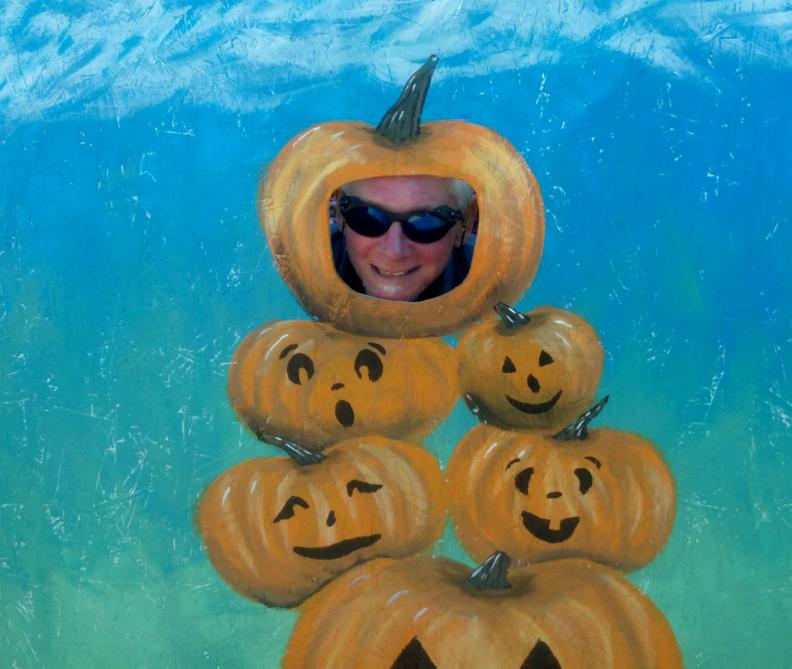
punkInHead.jpg

Later that week I BARTed to SFMoMA for some more culture. Besides a lovely Weston Pepper print they had an installation by Rafael Lozano-Hemmer -- whose pieces I'd just seen at Bitforms in NYC:
Voice Array
Voice Array
and
Last Breath
Last Breath
Ed Osborn's Night-Sea Music -- which I'd seen in a SF gallery some years ago before he was famous...hah hah...and didn't know was on display here:

And the last day of Jim Campbell's Exploded Views, which I just happened to be viewing when he arrived to do an artist's talk:


After
a march down Market Street to The Zuni Cafe I managed to scam onto the prow-window-seat for dinner with Ken and Brian. I was too busy eating everything on the appetizer menu, including oysters of course, to take any photos. But I'll always have the memories, won't I?


Then down to Santa Cruz for a tour of the Art, Music, and DARC -- Digital Arts Research Center -- facilities with Sudhu, who is collecting keys and access codes at an alarming rate (he is also angling to get my old job running the electronic music studios). It took about 45 minutes to finally find the tiny buildings I remembered, hidden away in the forest.

On the way out I stopped at Waddell Creek, one of my favorite beaches just north of Santa Cruz, and touched the Pacific. There I found this small rivulet draining into the sea. I was too lazy to go back to the truck for the real camera so all I have is this schmutzy cell phone image:

Scale Free Image


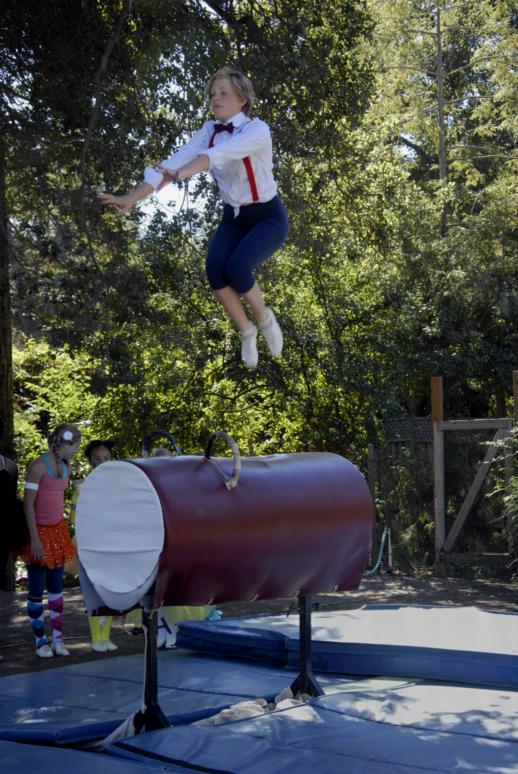
Three days in the sun at Jasper Ridge with Brooke and Deanna were capped by a Horse Vaulting Halloween party in Saratoga. Here's Natasha as Doctor Who getting some air on a barrel:

natashaJump.jpg
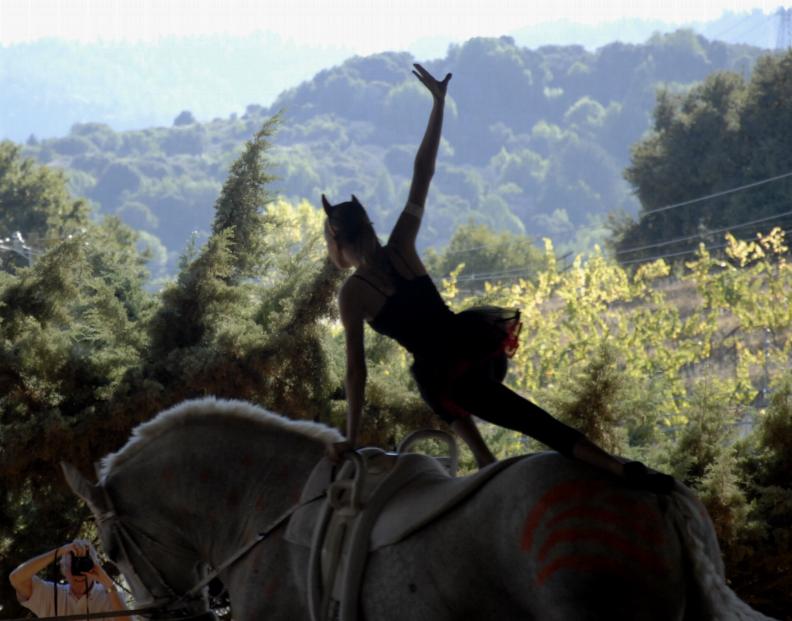
I got all setup to get some good photos of the main event but unfortunately she was always just getting into position as she passed my frame, so I didn't get a good picture on a real horse. However the place was chock-a-block with cute young devil-eared things so I managed to snap one of her team mates instead:
vaulting.jpg


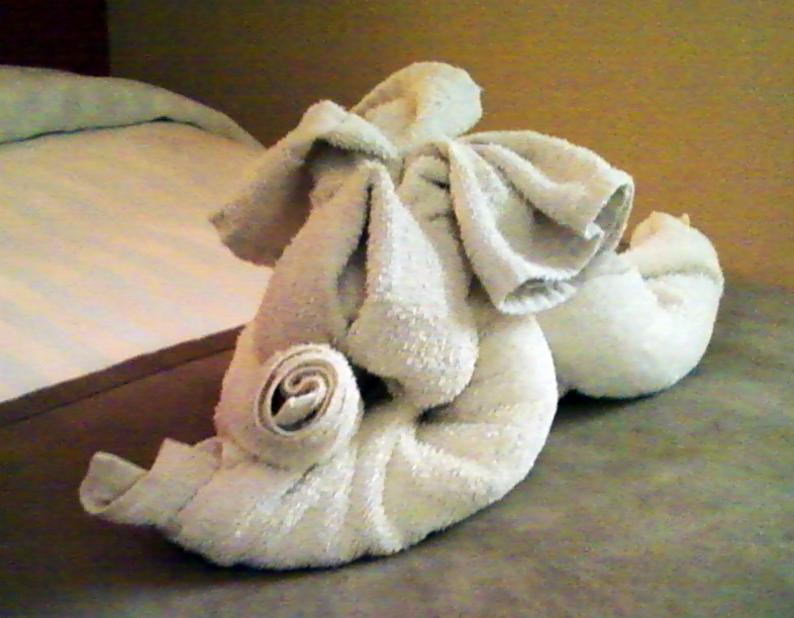
Then the excrutiating drive home via Eisenhower's lovely Interstate system. I hit Mojave at sunset just in time to see the full moon rise over the Eastern desert and found this in my Barstow motel room. I think it's a dog, but it could be a bunny:
towelDog.jpg

Night two was spent in Flagstaff's Hotel Monte Vista:
http://www.hotelmontevista.com/
 which features two bars. I selected the wrong one for my first martini(s) and then felt it necessary to sample the "correct" one. So the next day's drive to Santa Fe was a bit more challenging than it really needed to be...

But all in all it was an amazingly scenic and reasonably painless trip.
We now return you to our regular programming.

Saturday, October 27, 2012

additional information, misc

Reading the book Hans Haacke: Unfinished Business that I found at Moes I stumbled on his c. 1983 piece MetroMobiltan which externalizes the relationships between the Metropolitan Museum and it's corporate funding tits by examining the influence that Mobil Oil had on the show, Treasures of Ancient Nigeria. It also extends the thesis that the then Met director, Thomas Hoving, innovated the whole concept of corporate blockbuster funding. Looking a bit deeper (actually quite a bit, as this particular type of information is not so easy to find online) I found that my memory was correct that, 1) The 1972 (1976 in the US) Treasures of Tutankhamen was the first popular blockbuster; and, 2) It was funded -- in the National Gallery at least -- by Exxon, c.f.: http://www.nga.gov/past/data/exh410.shtm

That last little tidbit is the hard part to find as all the gee-whiz online information about these hugely popular shows conveniently ignores who paid for them.

Anyway.... My point is that the early '70's date exactly lines up with the end of the big Art-Tech shows which were, 1) Funded by large corporations -- Pepsi, Phillips, Bell Labs, AMC, etc; and, 2) Contained new work that was research oriented -- rather than greatest hits from the past. So, what happened was that our corporate masters realized that they could get much more bang/buck out of old dead artists than they could from work that better aligned with their scientific and engineering pursuits. And PFFFTT went the collaboratory milieu.

Fortunately, I Am a Sensitive Artist, so I don't actually have to support this hypothesis with actual data...


In Other News

Something has changed about the Lazzaroni Amaretti Cookie wrappers. They no longer fly. The paper doesn't form the ash chimney as shown in the video. It appears that it is not just me as I've found a number of complaints online dating from 2008. But no explanation. I would have at least expected the box to have a warning and liability disclaimer about lighting anything on fire.

The only constant is change. For the worse.

Tuesday, October 23, 2012

The Trip So Far

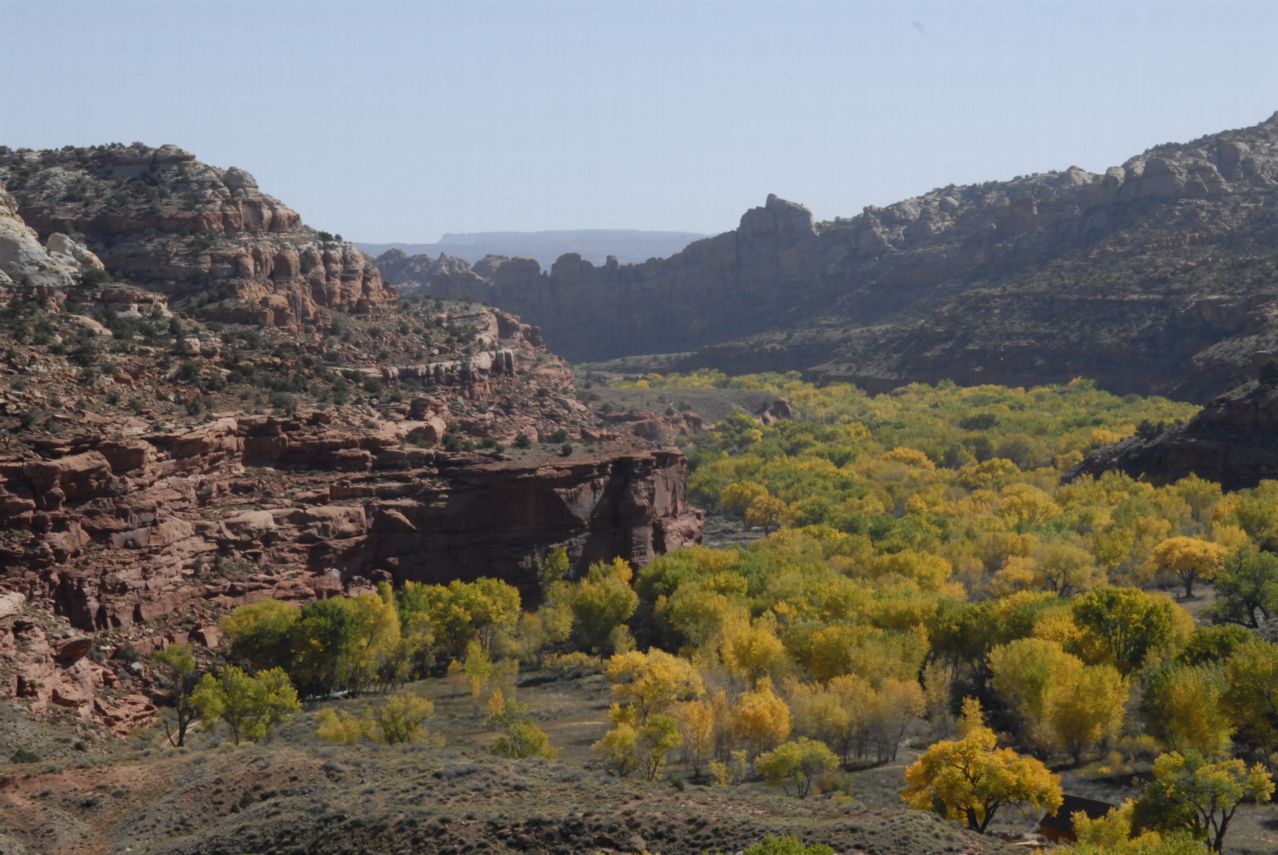
I'm in the midst of a road trip from Santa Fe to the Bay Area -- and presumably back. I took the scenic route through southern Colorado, Utah, and Nevada. The leaves were turning:

view from Kiva Coffee on Utah Highway 12
and there were only a few Romney-Ryan signs to be seen in the clutter of local election trivia. I have not seen a single Obama-Biden sign, even here in Berkeley though. It could be that we just don't care anymore?

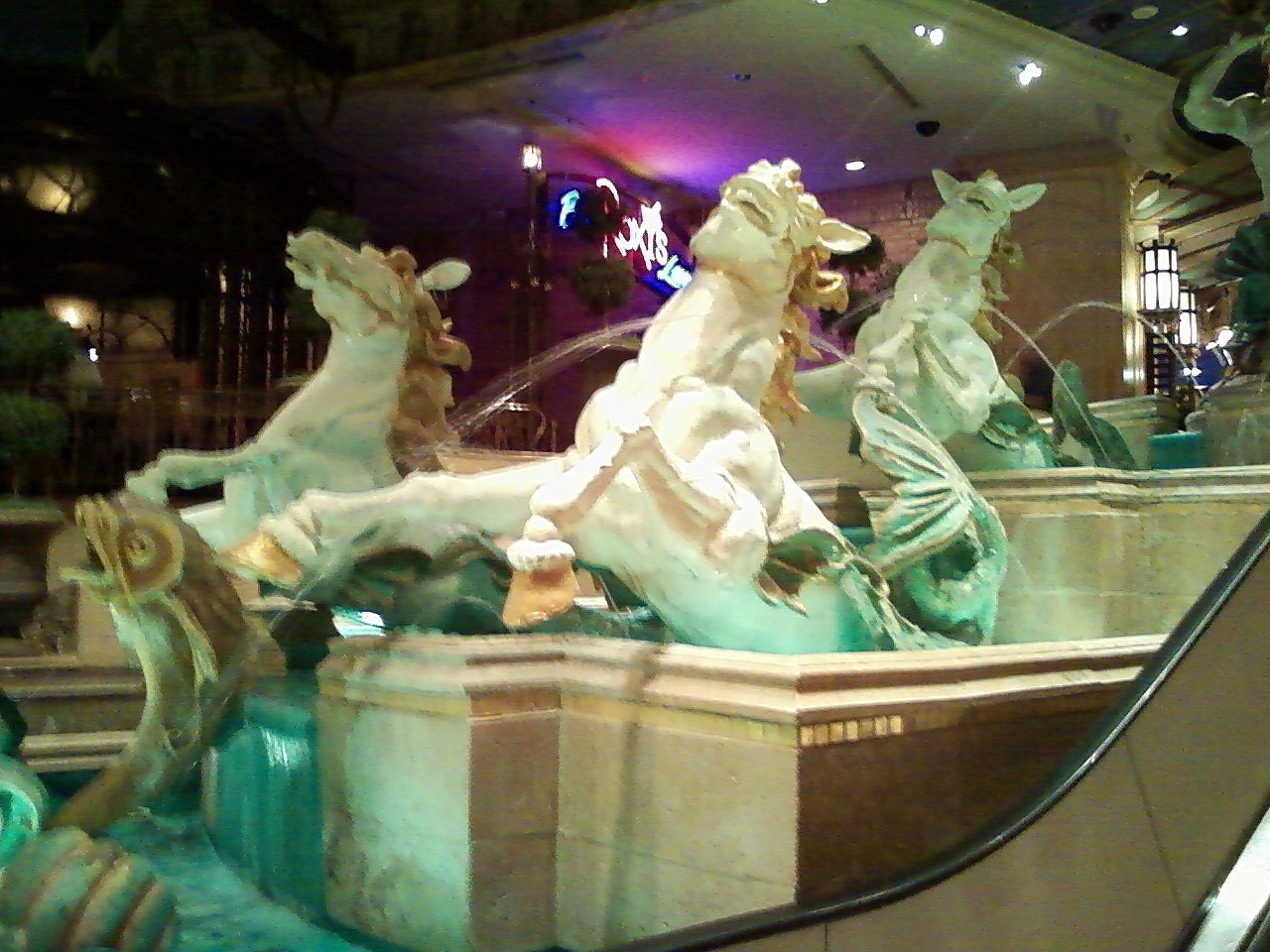
Following the grueling ups and downs of NV Highway 50, I over-nighted at Circus Circus in Reno. I can definitively say that I have now seen the present and it is omnipotent:

underground dividing line between Circus Cicus and Eldorado casinos
The downtown casinos seem to be connected via mazes of underground passages full of flashing lights and bleeping sounds, all watched over by security cameras of amazing grace (one camera got facial shots of everyone who entered a particular restroom complex). In a cultural full-court-press, I was served all-you-can-eat-average-sushi by an tiny older Japanese woman, sporting a "Godzilla" name tag, working in a place called Kokopelli's Sushi at the back of Dos Geckos Cantina somewhere underneath Circus Circus. I also couldn't figure out how to give them any of my money because there are no longer coin operated slot machines. I think you need to plug your credit card directly into all the devices so as to make the draining of your accounts more efficient.

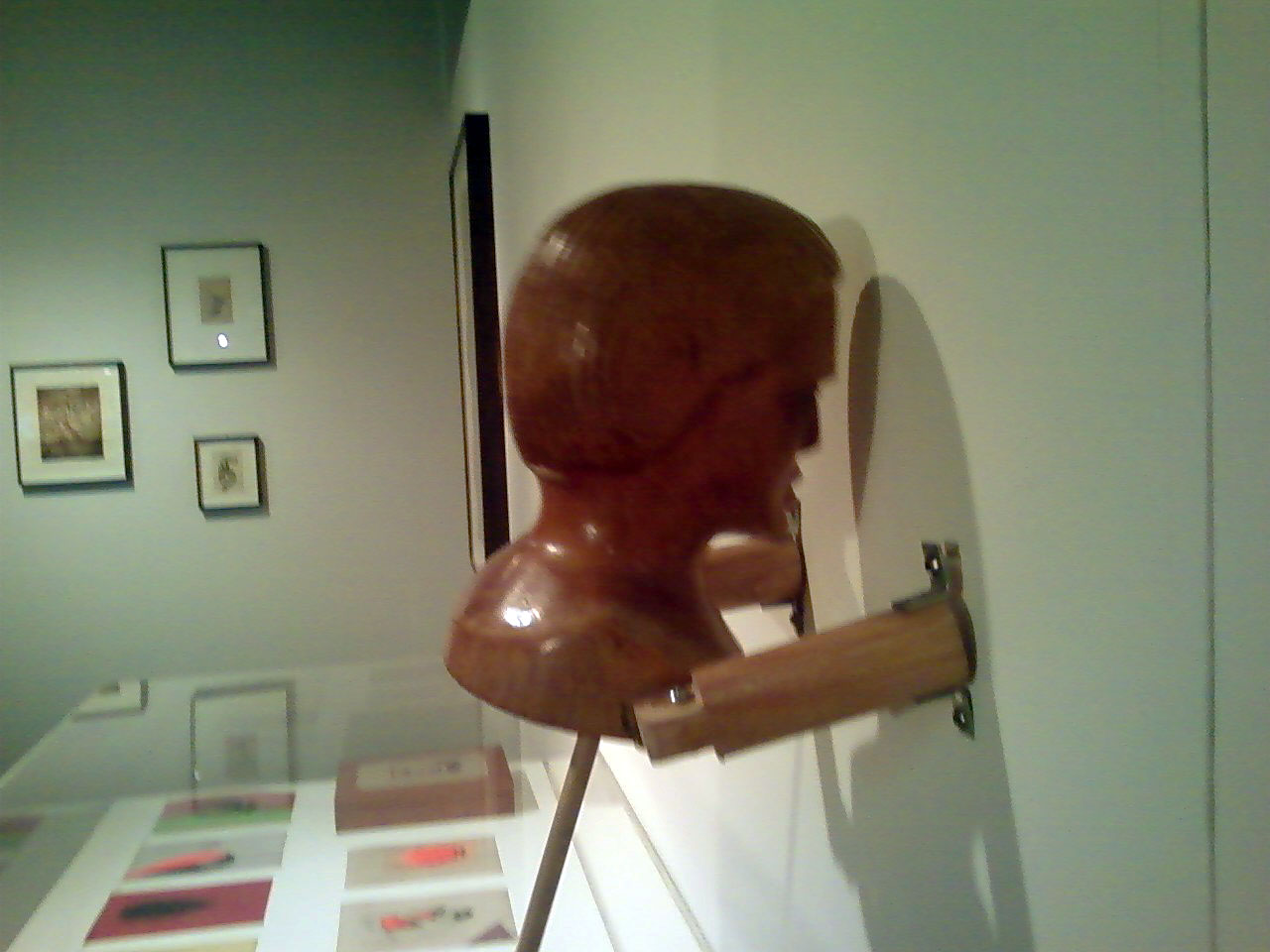
Thankfully, I got out of town the next morning and through the Sierras to the b.Area without further incident. The Berkeley Art Museum has a show of graffiti-street art stuff which I found to be mostly uninteresting. The mechanized spray-boys sprinkled around the space were kinda fun -- variously sized figures with mechanical arms holding spray cans, pretending to tag whatever they could. However...upstairs:

Barry McGee's head

The same motor-crank mechanism is used to bang this guy's head against the wall with a satisfying clunk-clunk-clunk. And on the top floor is a review of recent acquisitions which are well signed and in many cases actually thoughtful and interesting. I'm off to the real Maudlin Art Museum in da-city later today -- there may be more art reportage later. I also found one of the Hans Haacke books I wanted at Moes, so all is not yet lost.

Then I went to the old Berkeley Bowl:

an acre of fruits and vegetables at Berkeley Bowl

And nearly broke into tears...

All this plus oysters at Cafe Rouge, Sushi at Uzen, a Sazerac at Cesar, and the Zuni yet to come.

Saturday, October 13, 2012

Double Order of Nostalgia


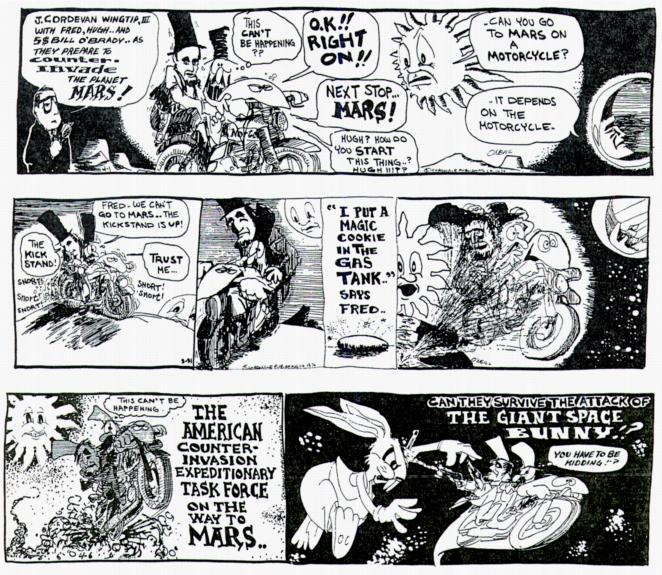
While rummaging through the "Schippling Archives" I found an envelope full of copies of one of my favorite comic strips: Odd Bodkins by Dan O'Neill. I looked him up and he seems to be still kicking AND a fellow blog-site user. I encourage you to peruse the aforementioned link...

There are two Odd things about my history with this comic strip:
  1. I first saw the strip in the mid-1960's in the Riverside Press Enterprise, one of the most editorially conservative publications you could find in those roaring days of John Birch. It was the weirdest thing I'd ever seen.
  2. Twenty years later I would (and still) own a Norton Commando motorcycle. To my shame I've never given him a Magic Cookie.

I do however live with a rather large Space Bunny...